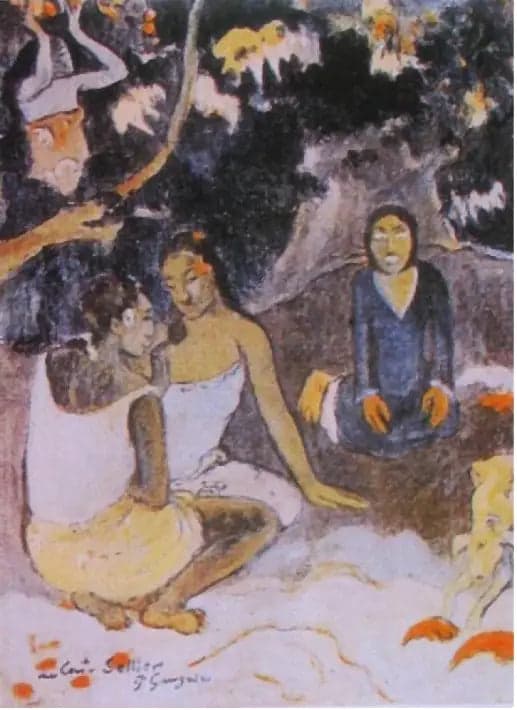
Barbaric Tales
- Original dimensions
- 28 x 39 cm
- Museum
- Tel Aviv Museum of Art
- Year
- 1892
Scene depicted
The scene depicted in Barbarian Tales evokes the intimacy of a moment where ancestral myths blend with the reality of daily life. On this canvas , the viewer is invited to dive into a narrative that is both human and universal, where the solemnity of ancestral rites clashes with encroaching modernity. The figures, eloquent and mysterious, transport us to a dimension where the sacred and the profane coexist.
Historical context
Created in 1892, at the height of the post-impressionist movement, this painting emanates from a Paul Gauguin in search of new forms of artistic expression. Set against a rich backdrop of secessionist movements, Barbarian Tales evokes the complexity of a world that is both dependent on the West and deeply rooted in ancestral traditions. Currently, this canvas is located at the Tel Aviv Museum of Art , where its dimensions of 28 x 39 cm reveal the intensity of the composition.
Place in the artist's career
Barbarian Tales fits into a revolutionary period of Gauguin's career, characterized by a bold stylistic search. This painting lies between the exuberant Vision of Duality and the emblematic Where Are We Going? , illustrating the artist's transition to more symbolic and evocative compositions, supporting his quest for meaning and identity.
Anecdote
“The painting is a silent cry for those who know how to listen.” Thus might Gauguin have said while reminiscing one morning on the slopes of Tahiti. For him, each brushstroke was a conversation with the invisible. This canvas , cradled by the echo of distant adventures, captures the intensity of a suspended moment, where the past and present intertwine.