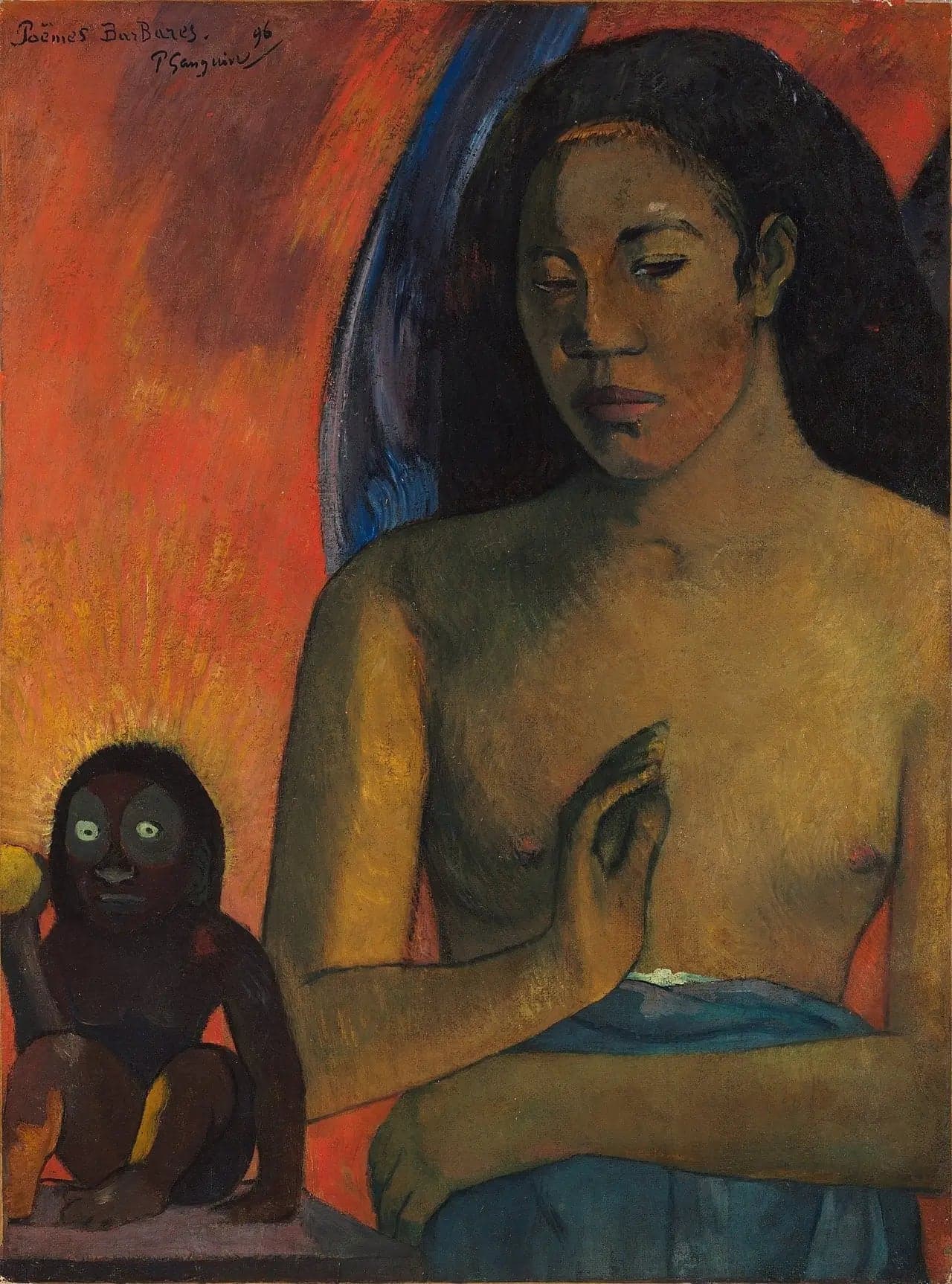
Barbaric Poems
- Original dimensions
- 48.3 x 64.8 cm
- Museum
- Fogg Art Museum
- Year
- 1896
Scene depicted
The painting “Barbaric Poems” swims in an atmosphere of mystery and contemplation. Evoking hermetic figures, it transports us into a universe where emotions are palpable. The motifs and colors of this painting tell ancient stories, connecting the artist to his Tahitian roots and his reflections on human nature.
Historical context
Created in 1896, this painting emblematic of Paul Gauguin is the result of an era marked by the artistic movements of the late 19th century. Captured in France, this work represents a period when Gauguin moved away from impressionism to explore the depths of symbolism and primitivism. Now exhibited at the Fogg Art Museum , this canvas of 48.3 x 64.8 cm is a vibrant testimony to the bold ideas that were at play at the time.
Place in the artist's career
With “Barbaric Poems,” Paul Gauguin positions himself at a crucial turning point in his career. This painting represents a phase of artistic maturity, similar to works such as “The Vision after the Sermon” and “The Yellow Christ,” where he pushes his technique to the extreme, juxtaposing color and symbol to create a unique emotional intensity.
Anecdote
“My brushes are my wandering companions, and each canvas is a poem that I lay on the canvas.” These words resonate by drawing from the inspiration that Gauguin experienced in the soothing alleys of Paris one spring morning. In this context, Barbaric Poems reveals itself as a pictorial work full of promises, foreshadowing the artist's quest for identity.