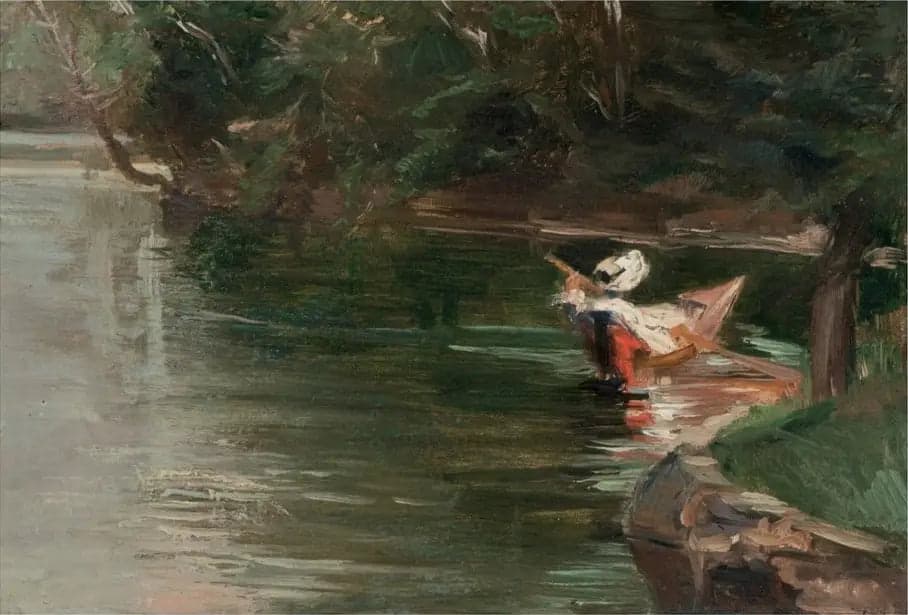
Banks of the Yerres
- Original dimensions
- 22.5 x 15.6 cm
- Museum
- Not specified
- Year
- 1878
Scene depicted
The scene in Bords de l'Yerres transports us to the edge of a calm river, where the reflections of light in the water converse with the surrounding greenery. Figures stand on the banks, enjoying the natural setting that surrounds them. Caillebotte manages to immortalize moments of daily life, blending the natural and the escape in a subtle composition, each element vibrating with a unique light.
Historical context
Created in 1878, the painting titled Bords de l'Yerres represents a bucolic scene along the Yerres river, located in France, in the Île-de-France region. This painting is part of the artistic movement Impressionism , an emerging movement that challenges the conventions of traditional painting. At that time, Gustave Caillebotte played a key role within this movement, seeking to capture light and urban life in an innovative way. The canvas, a living testimony of this era, is today preserved in a private collection.
Place in the artist's career
Bords de l'Yerres represents a crucial step in Caillebotte's career, marking his artistic evolution at a time when he asserts himself as one of the pillars of Impressionism . Alongside other works such as The Floor Scrapers and The Bridge of Europe , this canvas bears witness to a style in full maturity, blending bold technique and deep sensitivity. Caillebotte excels in the representation of light and movement, the two essential elements that animate his compositions.
Anecdote
“It only takes a simple breath of wind to awaken the beauty of the water's edge.” These words from Gustave Caillebotte could summarize the very essence of his masterpiece . This moment of clarity, captured on a spring morning by the Yerres, reveals a serene nature where the artist found his inspiration. The painting conveys a call to contemplation and peace, creating an atmosphere conducive to escape.