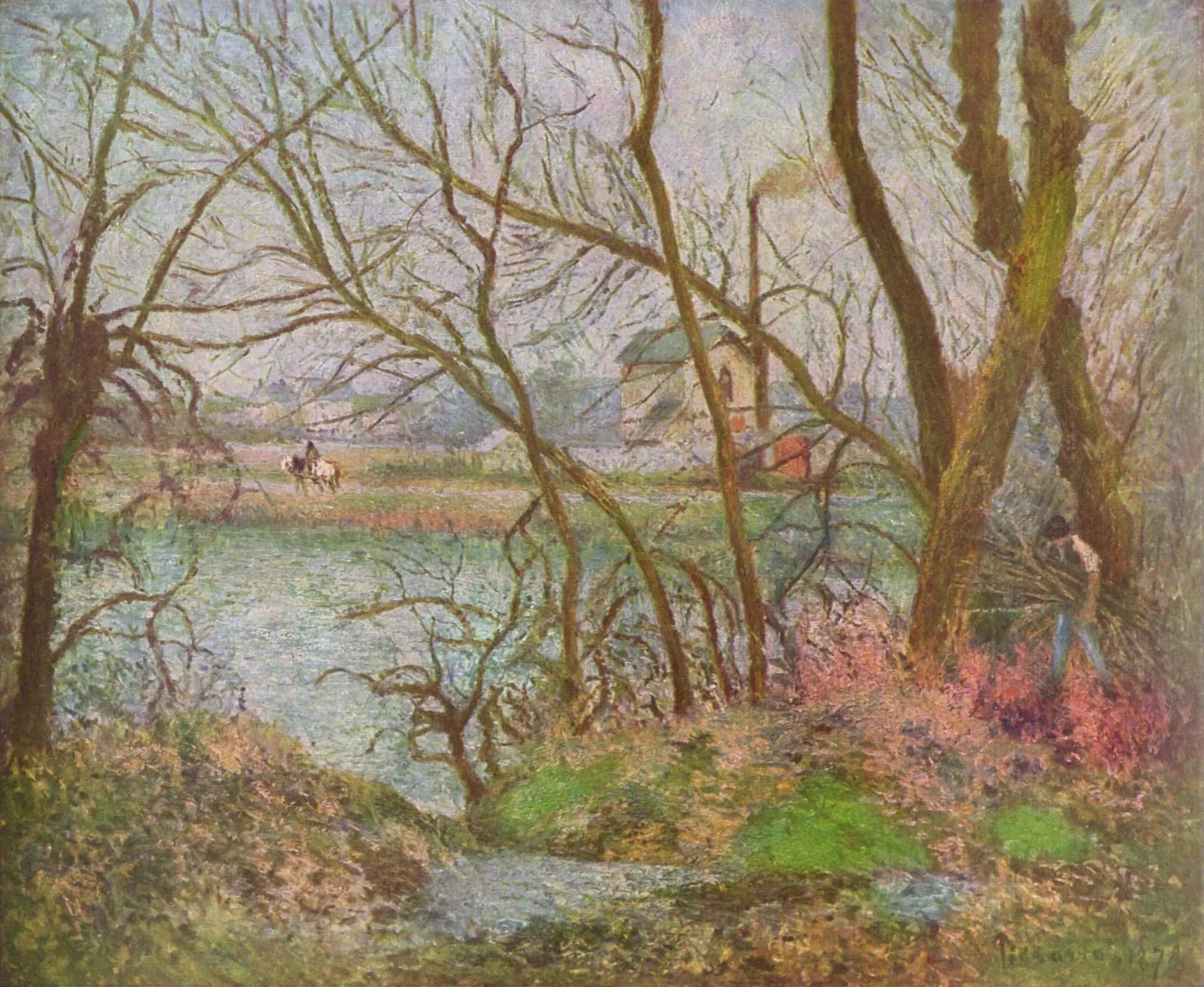
Banks of the Oise, near Pontoise, gray weather
- Original dimensions
- 65.5 x 54.5 cm
- Museum
- Orsay Museum
- Year
- 1878
Scene depicted
This painting evokes the tranquility of the banks of the Oise, depicting a landscape enveloped in a melancholic atmosphere. The gray and cloudy hues intertwine, bringing the composition to life. The human figures, taking a secondary place, harmonize with the surrounding nature, while the softness of the filtered light gives the whole a rare and touching poetry. This painting thus becomes a reflection of a simple daily life, magnified by the painter's eye.
Historical context
Created in 1878, this painting is an iconic representation of a picturesque and bucolic scene of the banks of the Oise, near the charming town of Pontoise, in the heart of the Île-de-France region. Camille Pissarro , a key figure of the Impressionist movement, captures here the essence of his time, a moment when light and natural atmospheres become the true protagonists of his canvas . Today, this work is located at the Orsay Museum , where it continues to amaze thousands of visitors.
Place in the artist's career
Banks of the Oise, near Pontoise, gray weather represents a significant step in Pissarro's career. This painting bears witness to his stylistic evolution, where Impressionism matures. Alongside other works like The Potato Harvest and The Boulevard Montmartre, Spring , it illustrates how he translates changing light and the harmony of rural life, affirming his integration within the Impressionist movement.
Anecdote
“Nature is the greatest of artists, and every moment spent observing its variations is a lesson for the soul,” said Pissarro. While painting this masterpiece , he was inspired by an autumn morning, where the mists delicately rose over the calm waters of the Oise. In this painting, the serene gaze and the end of the grayness intertwine, revealing the emotional depth of this masterpiece .