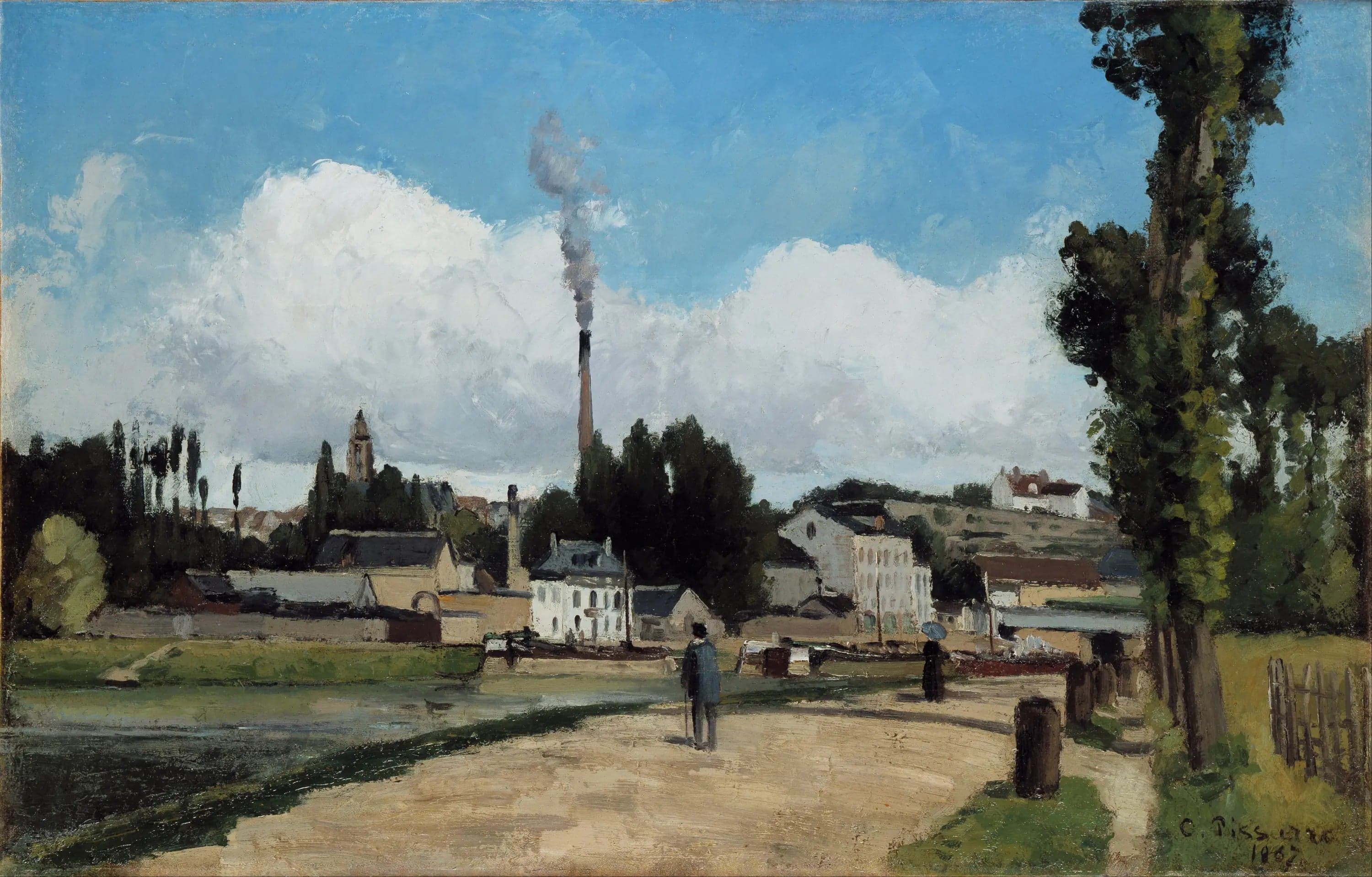
Banks of the Oise at Pontoise
- Original dimensions
- 65 x 54 cm
- Museum
- Mohamed Mamoud Khalil Museum
- Year
- 1874
Scene depicted
This painting evokes a calm and serene scene, where the Oise winds between lush banks. The characters, caught in their daily lives, are set against a backdrop that pulses with soft, golden light. The canvas narrates the symbiosis between man and nature, connecting the physical world to a palpable emotional depth.
Historical context
Created in 1874, this painting is a living testimony of Pontoise, a picturesque town in France, during the time of the Impressionist movement. Emerging in a context where nature and light were the main subjects of inspiration for artists, Banks of the Oise at Pontoise subtly captures the essence of this era. Today, this canvas resides in the collections of the Mohamed Mamoud Khalil Museum, where the harmony of its dimensions, 65 x 54 cm, offers an immersive view of a moment frozen in time.
Place in the artist's career
Banks of the Oise at Pontoise marks a key evolution in the career of Camille Pissarro . It represents not only a moment of artistic maturity but also a transition to a bolder palette, similar to that of his other famous pieces like The Road to the Valley of the Oise and The Place of the French Theater . This work is undoubtedly a milestone, bearing witness to his journey through Impressionism .
Anecdote
"Nature is my best teacher," said Pissarro as he sought to capture the brilliance of a spring morning by the Oise. While contemplating a scene of a peaceful river, he felt the irresistible call of painting . Through Banks of the Oise at Pontoise , this quest for truth transforms into a sensory ode to the fragile beauty of nature.