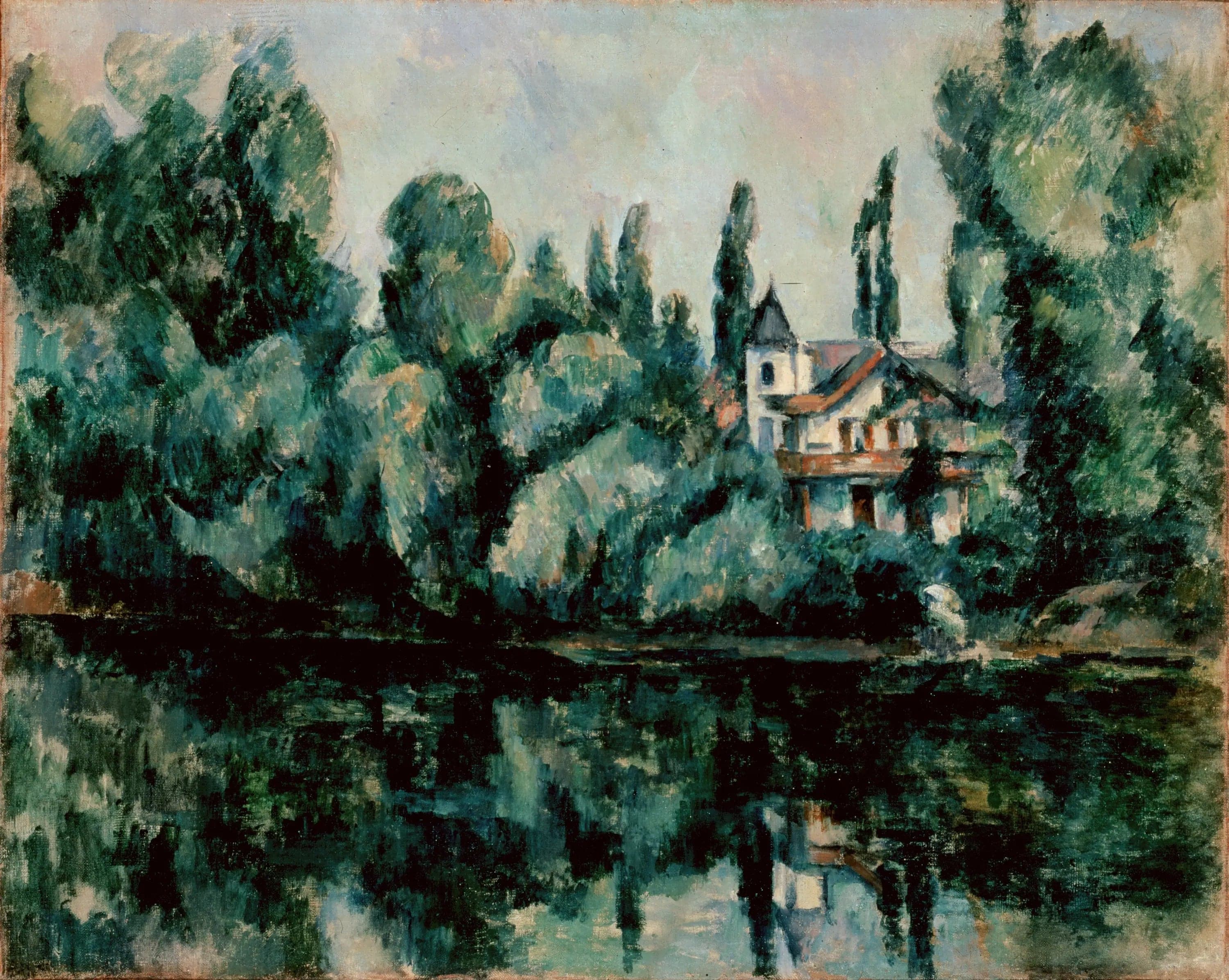
Banks of the Marne
- Original dimensions
- 81.3 x 65.5 cm
- Movement
- post impressionism
- Museum
- Hermitage Museum
- Year
- 1888
Scene depicted
Bords de Marne reveals a peaceful scene where nature takes on its full extent. Through his brush, Cézanne testifies to the serene beauty of the banks of the Marne, his painting being a harmonious composition of lush greenery and sparkling waters. The tranquility of this environment transforms into an invitation to contemplation, an escape to landscapes imbued with sweetness.
Historical context
Created in 1888 in the bucolic and peaceful setting of France, this iconic painting, Bords de Marne , is part of the post impressionism movement. The work of Paul Cézanne offers a vibrant testimony of a time when painting freed itself from classical forms. Currently exhibited at the prestigious Hermitage Museum , this canvas unfolds dimensions of 81.3 x 65.5 cm, thus capturing the essence of a living and vibrant nature, conducive to artistic inspiration.
Place in the artist's career
Positioning Bords de Marne as a significant work in Cézanne's career, it is observed as an essential milestone, testifying to a promising beginning in his artistic maturation. Alongside other masterpieces such as The Large Bathers and Mont Sainte-Victoire , this canvas reveals the rich and varied evolution of his unique style, oscillating between the figurative and the abstract.
Anecdote
“Nature is one through every brushstroke, it has always drawn me towards its endless brilliance.” These words of Cézanne resonate like an echo of spring mornings when he settled by the Marne, capturing the light that danced on the waters. In painting Bords de Marne , he crystallized a precious moment, a feeling of peace and harmony that permeates his pictorial work.