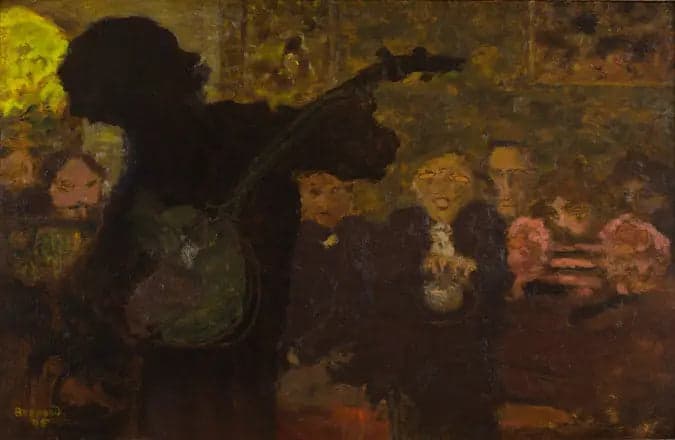
Banjo Player
- Original dimensions
- 66.7 x 43 cm
- Museum
- Orsay Museum
- Year
- 1895
Scene depicted
The painting "Banjo Player" features a young musician, his gaze captivated by his passion, while the banjo resonates in the air. The canvas reveals a vibrant composition, where the notes seem to dance and float around the character. Bonnard, with his unique palette, captures not only the musician but also the light and joyful atmosphere surrounding him, evoking a lively and delicate ambiance that envelops the viewer.
Historical context
Created in 1895, in the heart of Paris, this oil painting is not just a simple representation, but the vibrant essence of an era dominated by the Nabi movement. The painting, currently housed in the Orsay Museum , is set against a backdrop of artistic innovation and personal expression, where Bonnard, through his bold use of color and light, immortalizes moments of life. The dimensions of this canvas, 66.7 x 43 cm, reveal an intimate format that invites delicate observation of its details.
Place in the artist's career
In Bonnard's career, "Banjo Player" represents a moment of maturity, a style in full evolution. At this time, the painter begins to develop his unique approach: a footprint between intimacy and fervor. Compared to other iconic works such as "Luncheon on the Grass" and "The Garden at Vernon," this painting reveals how the artist deepens his exploration of color and everyday life.
Anecdote
"Music is the soul of my art," Bonnard might have said, recalling the enigmatic moment when he encountered a banjo player in a lively alley in Paris. This vibrant moment, imbued with melody and light, provided him with the necessary impulse to create this masterpiece. The emotion emanating from this painting resonates with the spirit of the time, inviting the viewer to feel this palpable magic.
Major exhibitions
The Black Model from Géricault to Matisse