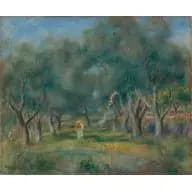
Avenue of the Olive Trees - Pierre
- Original dimensions
- 56 x 47 cm
- Museum
- Baltimore Museum of Art
- Year
- 1905
Scene depicted
The painting "Avenue des Oliviers" transports the viewer to a shaded path, where the olive trees dance under the caress of a light breeze. This painting is an invitation to stroll, evoking the scent of flowers and the whisper of leaves. The scene is bathed in an atmospheric softness, where each nuance is a call to contemplate the simple beauty of life.
Historical context
Created in 1905, during a spring imbued with artistic effervescence, the painting "Avenue des Oliviers" is at the heart of impressionism , a movement that celebrates light and movement through delicate strokes. At that time, Renoir, in the full maturation of his art, did not imagine that this canvas would become an emblem of his work. Currently, this exceptional painting is preserved at the Baltimore Museum of Art , radiating in a setting that pays tribute to it.
Place in the artist's career
With "Avenue des Oliviers," Renoir rises to the forefront of the impressionist world. This painting, just before his bolder works such as "The Bathers" and "Luncheon of the Boating Party," represents a transitional stage, showing his quest for vibrant light and pure color. The contrast between these paintings reveals a captivating journey towards his mature style, bathed in cheerfulness and light.
Anecdote
Renoir had a phrase dear to his heart: "The beauty of things exists in the mind of the beholder." It is in a small village in the Provençal region, within a sunlit avenue, that he found the inspiration for this masterpiece . The fragrant and warm morning air promised a day rich in colors, revealing the magic of nature, the source of his muse.