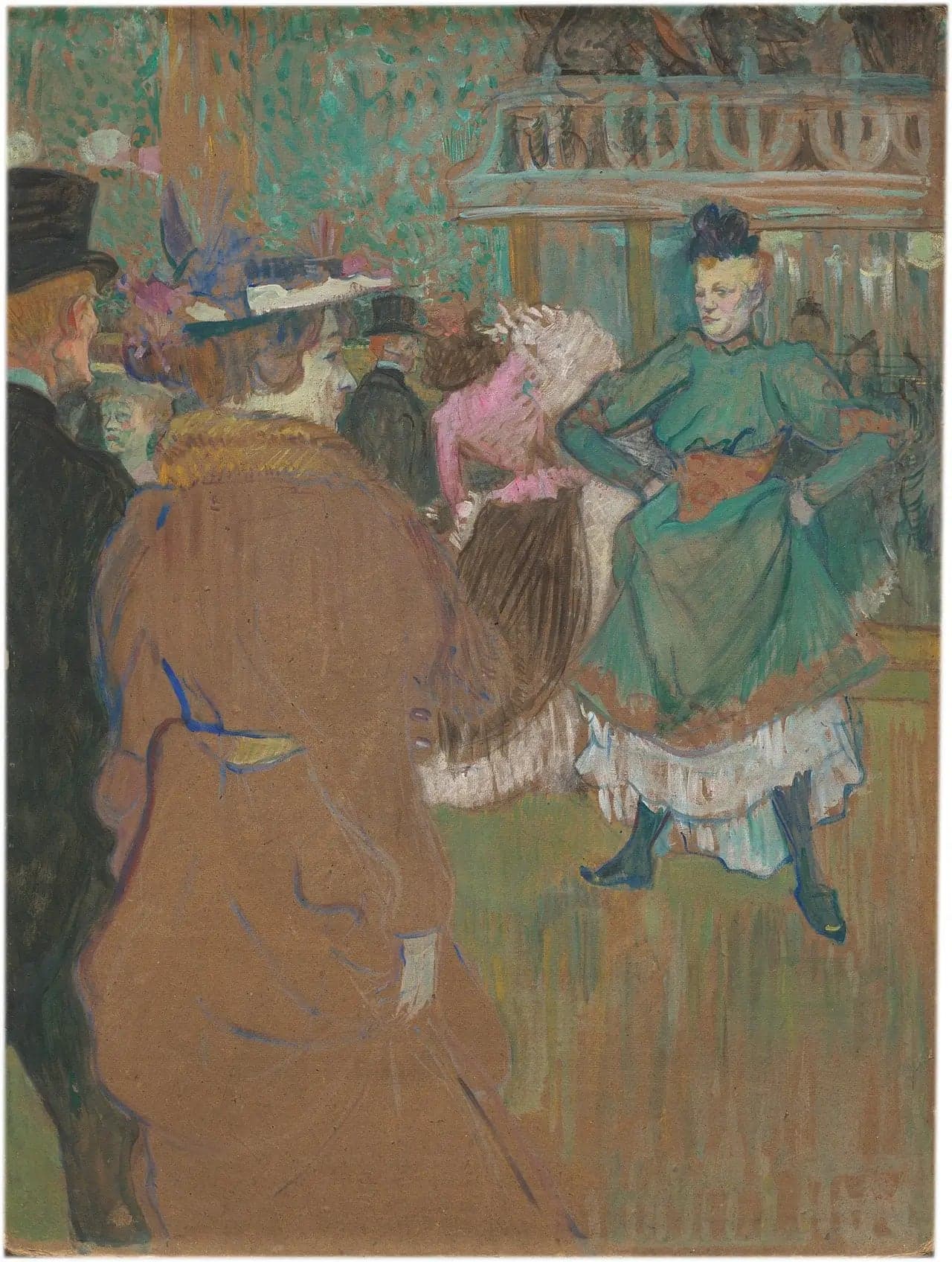
At the Moulin Rouge: The Departure of the Quadrille - Henri de Toulouse
- Original dimensions
- 59.8 x 81 cm
- Museum
- National Gallery of Art
- Year
- 1892
Scene depicted
This painting does not merely represent a simple event, but evokes the joy and chaos of an evening at the famous Parisian cabaret. We see cheerful couples, dressed in flamboyant costumes, ready to launch into an exhilarating quadrille. The scene, imbued with movement and energy, echoes the heartbeat of Montmartre's nightlife, resonating with the hearts of spectators to the rhythm of the ambient melody.
Historical context
In Paris, in the vibrant atmosphere of the Montmartre district, in 1892, Henri de Toulouse-Lautrec created this iconic painting . Immersed in the excitement of the Belle Époque, this painting is part of the post-impressionist movement that redefined the artistic vision of its time. Today, this pictorial work is carefully preserved at the National Gallery of Art , where its generous dimensions of 59.8 x 81 cm continue to captivate visitors.
Place in the artist's career
This painting is a major milestone in Toulouse-Lautrec's career, marking his emergence as a visual storyteller of Parisian life. Alongside other iconic paintings like "The Troupe of Mlle Églantine" and "Divan Japonais," this canvas depicts an evolution in his style, revealing a growing emotional connection with his subjects while perfecting his unique technique.
Anecdote
“An evening at the Moulin Rouge is a dance for the soul,” Toulouse-Lautrec might have said, evoking a starry night in Paris. This occurred during a fleeting moment, where the golden light of the lanterns mingled with bursts of laughter and the scents of the era, and he captured this nostalgic atmosphere in his canvas , transforming an ordinary celebration into a timeless masterpiece .