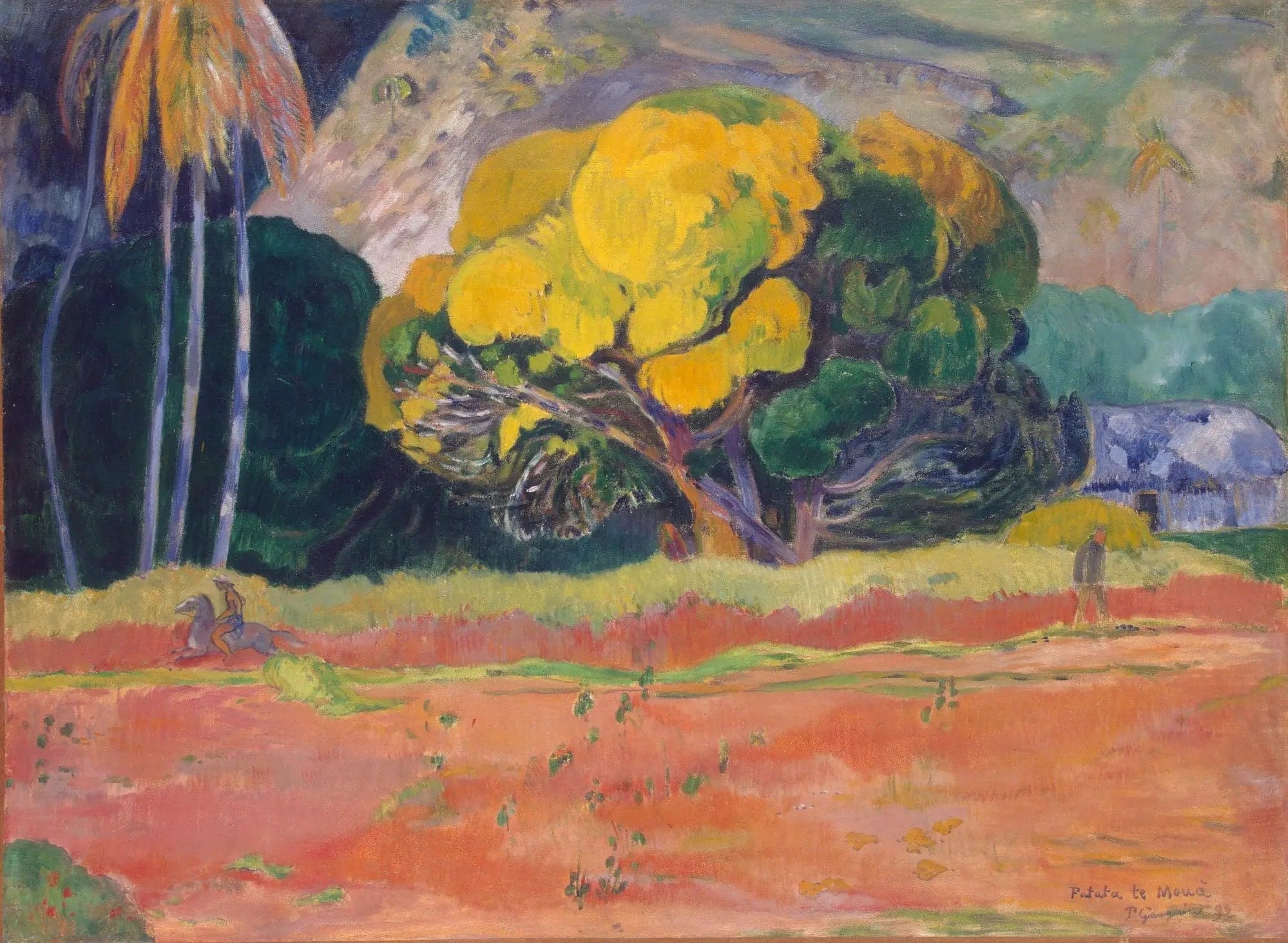
At the Foot of the Mountain
- Original dimensions
- 92 x 68 cm
Scene depicted
The scene of the painting “At the Foot of the Mountain - Paul Gauguin ” unfolds like an ode to nature. It reveals a bright panorama where the warm colors of the earth meet the deep hues of the sky. The majestic hills seem to embrace the landscape, while the lush vegetation testifies to a nature that is both peaceful and vibrant. This painting , with its uniform, captivating, and harmonious composition, resonates with the breath of natural elements and the very essence of life.
Historical context
Œuvre : At the Foot of the Mountain |BRK| Artiste : Paul Gauguin |BRK| Année : 1892 |BRK| Musée : Hermitage Museum |BRK| Lieu de création : France |BRK| Dimensions : 92 x 68 cm |BRK|
Place in the artist's career
“At the Foot of the Mountain” holds a special place in the career of Paul Gauguin , revealing his quest for new forms of expression. This masterpiece is part of a period when the artist begins to move away from academic conventions, similar to his other works such as “Vision After the Sermon” and “The Night of Waiting.” These creations testify to his bold aesthetic exploration and his resistance to traditional artistic movements.
Anecdote
Gauguin was often heard saying: “Painting is a word that enlightens the soul.” On a misty morning, while wandering the hills of Brittany, he captured the essence of this composition , a witness to the wild beauty emanating from the mountains and valleys. This profound feeling of connection to nature is found in the evocative power of the painting , while also being an invitation to escape.