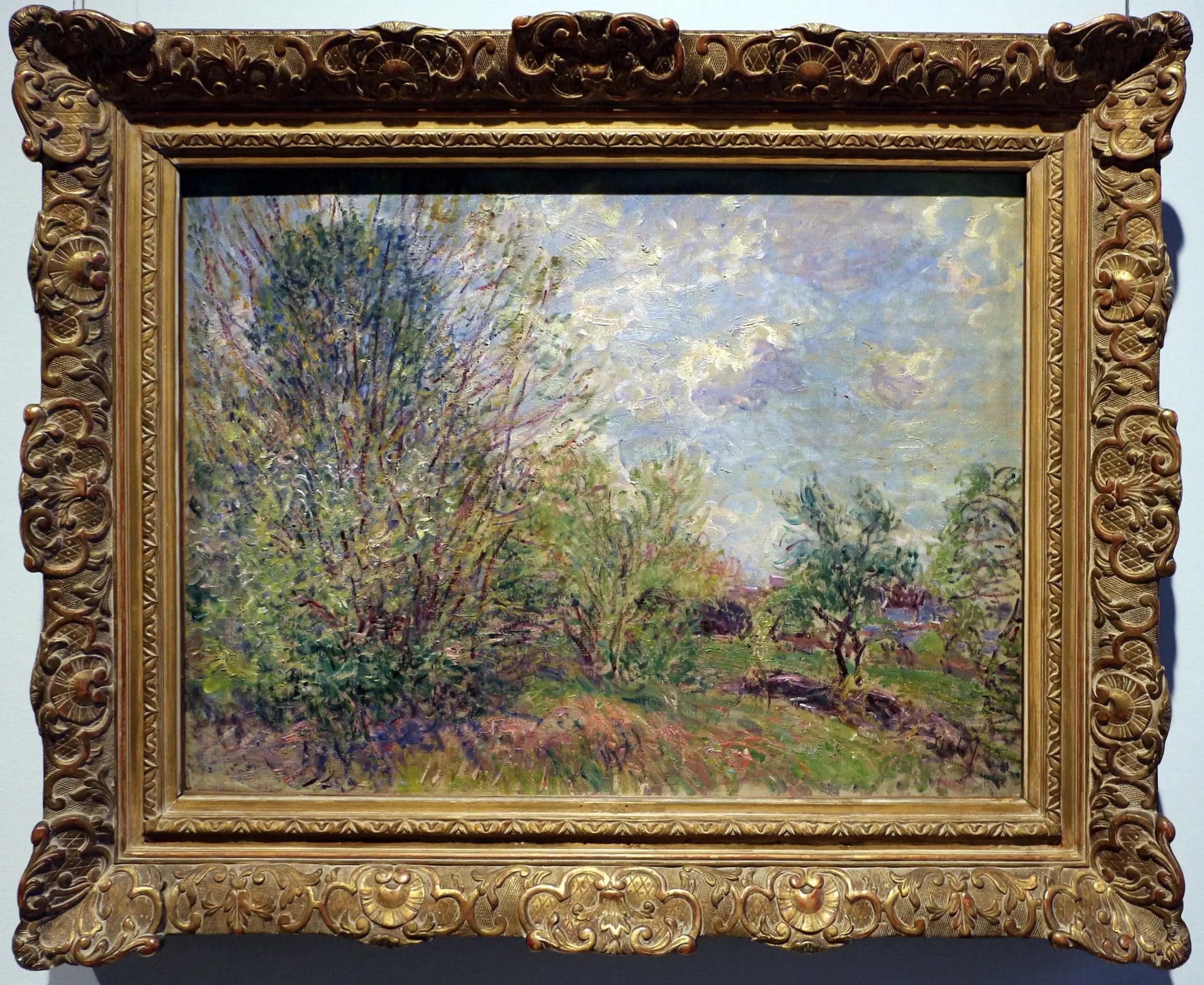
At the Edge of the Wood / Landscape. Spring
- Original dimensions
- 72 x 53 cm
- Museum
- Fin-de-Siècle Museum
- Year
- 1885
Scene depicted
This painting, titled “At the Edge of the Wood / Landscape. Spring,” represents a delicate spring landscape, where the blooming of nature rhymes with visual harmony. Sisley brilliantly captures the fleeting moment when the wood and grass awaken, bathed in a golden light that evokes renewal. His brushstrokes, lively and free, tell a story of rebirth and ephemeral beauty.
Historical context
Created in 1885 in Moret-sur-Loing, France, this iconic work is part of the Impressionist movement, which seeks to capture the light and ephemeral atmosphere of nature. Currently, the painting is housed in the Fin-de-Siècle Museum, an ideal setting for this masterpiece, highlighting its dimensions, 72 x 53 cm, which invite a more intimate contemplation.
Place in the artist's career
This painting stands as a key milestone in the career of Alfred Sisley , symbolizing his commitment to landscape and the present moment. Compared to other works such as “The Canal of the Grande-Île at Osny” and “The Powder Mills of Pont-de-Clais,” it demonstrates an evolution in his technique, moving from darker compositions to a vibrant and luminous palette.
Anecdote
Alfred Sisley , known for his keen sense of observation, once stated: “Light becomes poetry when we know how to listen to it.” Imagine him, that spring morning, sitting near the edge of the wood, captivated by the softness of the sun's rays filtering through the foliage. It is this precious moment that nourished the evocative power of this painting , where each brushstroke seems to celebrate this symphony of light and nature.