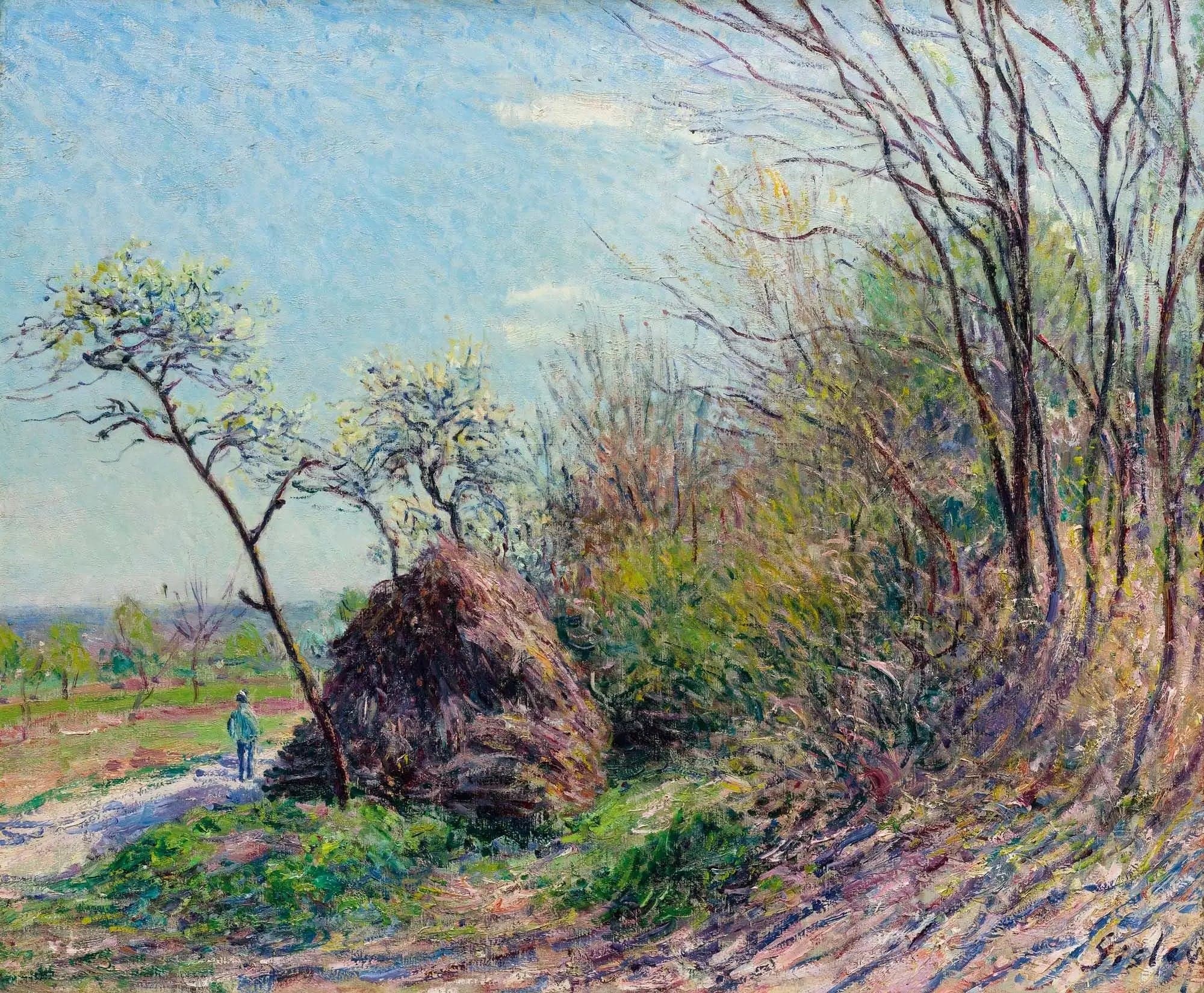
At the Edge of the Forest - Les Sablons
- Original dimensions
- 65.5 x 54.5 cm
- Museum
- Not specified
Scene depicted
In this canvas , Sisley captures a serene scene where the forest stands majestically. The green leaves, illuminated by soft rays of sunlight, seem to whisper secrets to those who take the time to observe them. It is here that nature offers refuge and respite, in a peaceful panorama, a true ode to ordinary beauty.
Historical context
Created in 1877, this painting is part of the Impressionist movement, emblematic of the 19th century. Alfred Sisley , from the French capital, depicts the beauty of the landscapes of the Parisian countryside, while playing with light and colors. The canvas , which remains in private collections, takes us on an exploration of nature, at the edge of the forests of the Fontainebleau region, where Sisley seeks to capture the sublime.
Place in the artist's career
At the Edge of the Forest - Les Sablons represents a significant milestone in Sisley's career, consolidating his Impressionist style. After his earlier, darker works, this canvas evokes a period of maturity, akin to The Water Lilies by Monet and The Saint-Lazare Station by Pissarro, both of which explore light and varied atmospheres.
Anecdote
“Nature is the true master. It is by contemplating it that I draw my inspiration,” Sisley is said to have remarked one morning by the river, enveloped by the light mist. This quote reveals the very essence of his masterpiece — an evocation of those moments when peace meets escape, translating into enduring emotions on the canvas .