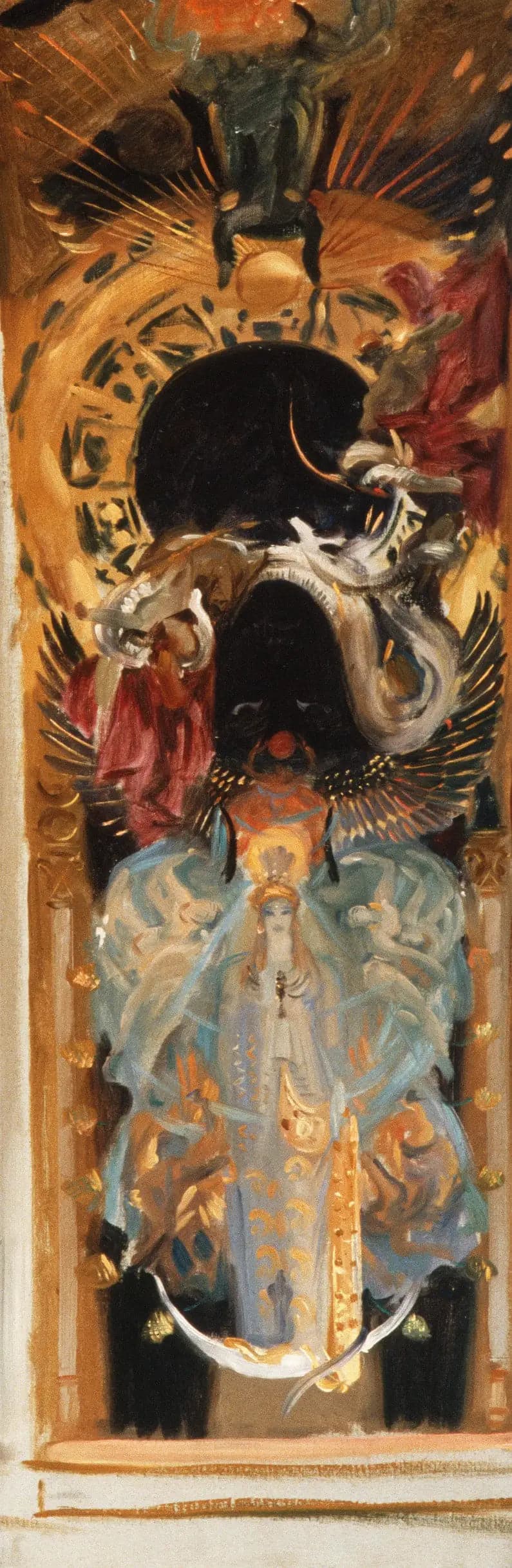
Astarte
- Original dimensions
- 30.5 x 98.1 cm
- Museum
- Metropolitan Museum of Art
- Year
- 1890
Scene depicted
In "Astarté," Sargent becomes the storyteller of a fascinating vision of femininity, featuring a young woman elegantly draped, symbolizing idealism and ephemeral beauty. The canvas delicately captures light, accentuating the graceful curves of its model who seems, at once, mystical and familiar. Each element of the scene evokes an air of serenity and enchantment, as if time had suspended its flight.
Historical context
Created in 1890, during the height of the Belle Époque in New York, this painting becomes a manifestation of the Impressionist movement, representative of the talent and technical finesse of one of the greatest masters of his time, John Singer Sargent . The canvas "Astarté" is currently exhibited at the Metropolitan Museum of Art , where it invites visitors to discover its intriguing history within a flourishing era of art and culture.
Place in the artist's career
"Astarté" is considered a milestone in Sargent's career, a transition to bolder compositions and elaborate plays of light. This painting is part of a series of iconic works, such as "Carnation, Lily, Lily, Rose" and "El Jaleo," where he explores perceptions of light and shadow, while weaving feelings of contemplation.
Anecdote
“Every brushstroke is a song, every color an echo of life,” Sargent confided, inspired by a summer morning to capture the timeless beauty of feminine forms. Thus, the moment of creation of this pictorial work reveals all the emotional intensity it contains, both in its subject and in its composition.