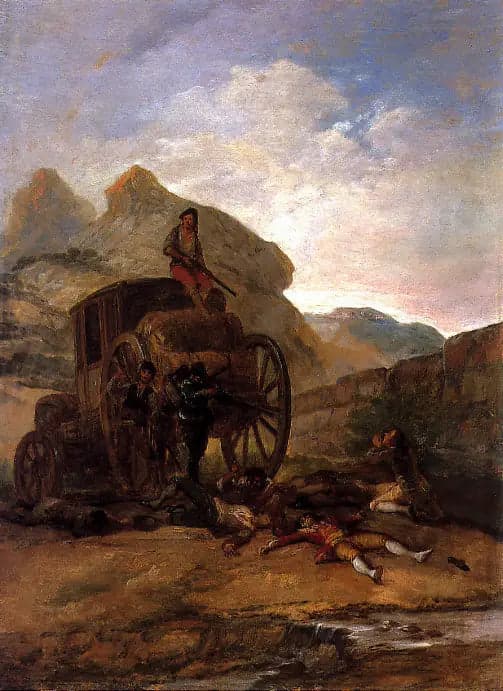
Assault of Thieves
- Original dimensions
- 32 x 50 cm
- Movement
- romanticism
- Museum
- Not specified
- Year
- 1793
Scene depicted
In this pictorial work, Goya depicts a scene of theft, where the tension is palpable. Thieves confront each other, and each figure carries a weight of emotional intensity. The dynamic composition and fluid movement make the violent interaction almost palpable, plunging the viewer into a tumult of adrenaline and anxiety. The canvas depicts not only a narrative but a heartfelt cry against the injustices of its time.
Historical context
Created in 1793, in Rome, the painting "Asalto de ladrones" is part of the romantic movement, captivating with its poignant representation of human struggles. At a time when Europe is experiencing social and political upheavals, this canvas becomes a reflection of the tensions of its time. Currently, it is preserved in a collection whose exact location remains obscure but whose dimensions bring a tangible intimacy to the work.
Place in the artist's career
“Asalto de ladrones” stands as a pivotal work in Goya's career, illustrating a transition to artistic maturity where psychological depth eclipses simple representations. Alongside “La Maja desnuda” and “The Executions of May 3, 1808,” this canvas reveals the evolution of an artist who dared to explore dark and complex themes. This journey led him to his status as a master of the dynamic and expressive painting.
Anecdote
“Every brushstroke is a cry of revolt.” This phrase still resonates today, evoking a male despair captured during an afternoon when Goya observed, in a Roman alley, the daily struggle of his contemporaries. This fleeting moment fertilized the artist's imagination, bringing to life his masterpiece , illustrating the struggle of the oppressed in an electrifying and immersive visual expression.