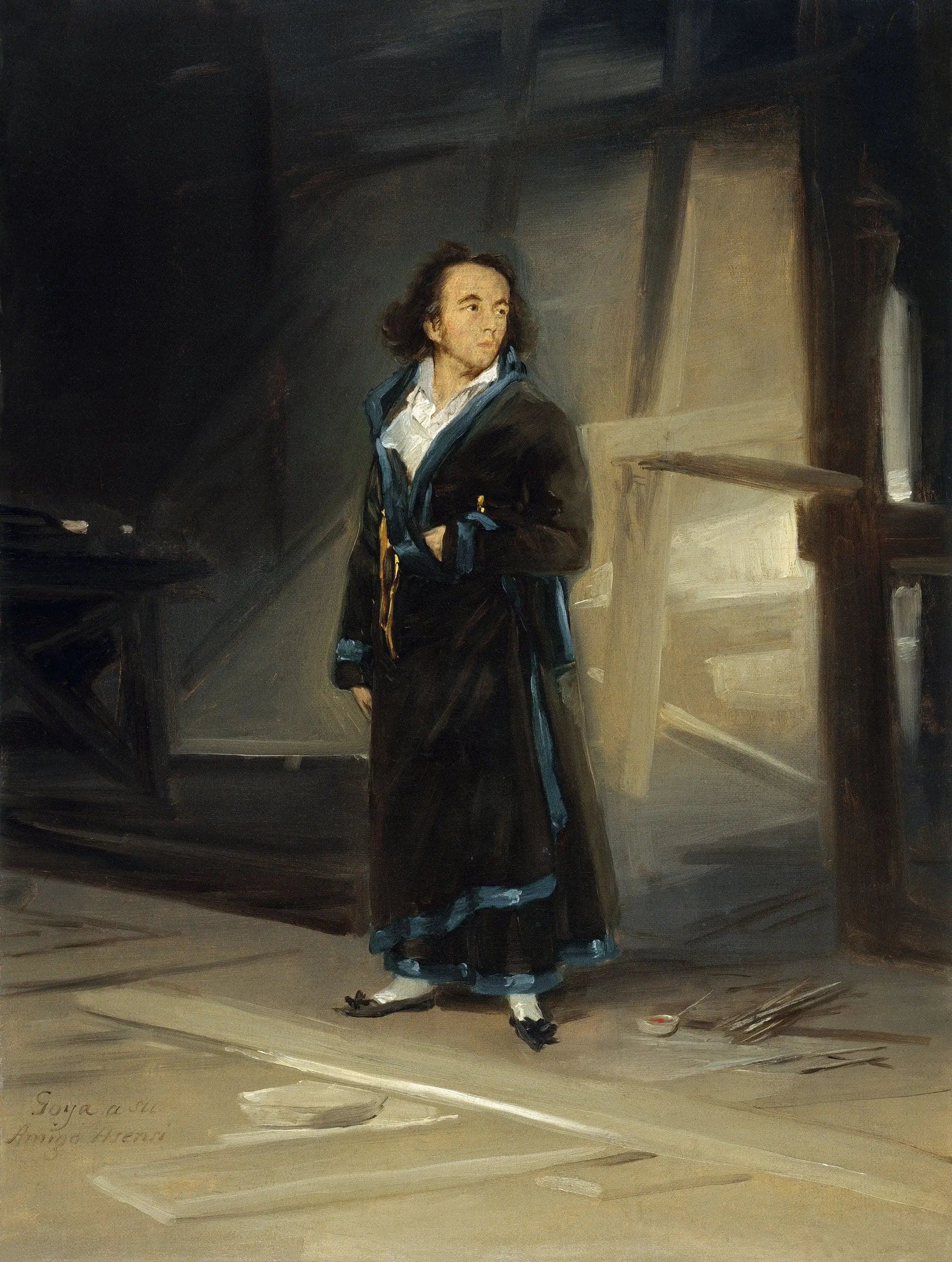
Asensio Julià
- Original dimensions
- 41 x 54.5 cm
- Museum
- Thyssen-Bornemisza Museum
- Year
- 1798
Scene depicted
The painting "Asensio Julià" painted by Francisco de Goya is a poignant representation of a young man with a thoughtful gaze. The scene, delicately composed, exudes an atmosphere of melancholy and introspection. The character, against a neutral background, seems absorbed in his thoughts, embodying an era where individuality and personal reflection take on their full meaning. This painting, both simple and complex, represents not only a portrait but also an echo of the deep feelings that inhabit each viewer.
Historical context
Created in 1798, this iconic painting finds its roots in Madrid, at the heart of a turbulent Spain, during a time marked by the beginnings of romanticism . Inscribed in the artistic movement of neoclassicism, this canvas beautifully illustrates Goya's stylistic evolution and his unique approach that marries rigorous technique with deep emotion. Today, this painting is wisely preserved at the Thyssen-Bornemisza Museum, surrounded by a collection that echoes the cultural richness of Spain during that era.
Place in the artist's career
"Asensio Julià" is situated at a turning point in Goya's career, where he begins to explore a deeper expressiveness and a bolder color palette. In parallel, one can mention works such as "La Maja Vestida" and "The 3rd of May 1808," which show an evolution from portraiture to a more engaging and emotional narrative. This painting seems both an intimate reflection and a foreshadowing of his upcoming style.
Anecdote
In Goya's words, "Art must not only capture the image but also the soul of the beings it represents." It is this reflection of humanity that resonates in this work. Perhaps it was on a sunny morning, in a narrow street of Madrid, that he caught sight of a face whose melancholy struck him and inspired this composition capturing both the beauty and human sadness.