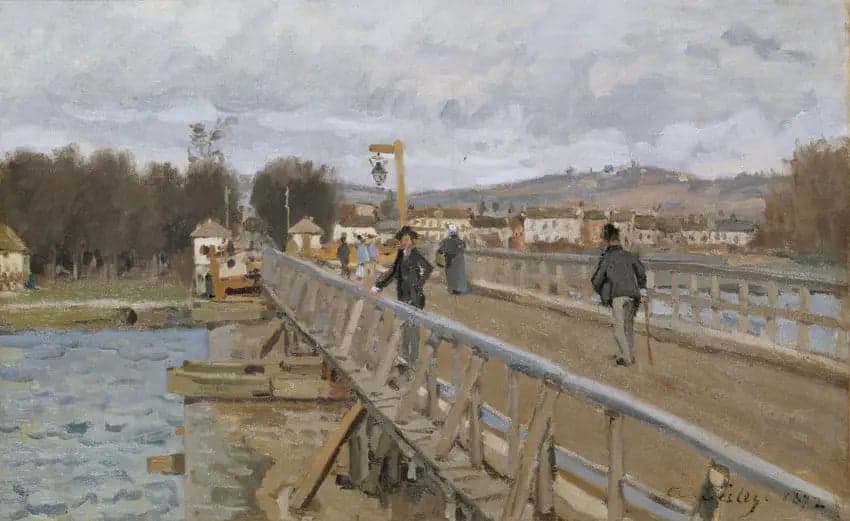
Argenteuil Bridge
- Original dimensions
- 60 x 38 cm
- Movement
- impressionism
- Museum
- musée d'Orsay
- Year
- 1872
Scene depicted
In this fascinating composition, Sisley immerses us in the heart of a suspended moment. The passerelle d'Argenteuil, with its delicate elegance, connects two banks, symbolizing human connection. Boats glide gently on the Seine, while the blue sky, dotted with fluffy clouds, shimmers on the water, creating a vibrant dialogue between nature and humanity. This painting reflects a time when time stands still, when the observer becomes an actor in this living tableau.
Historical context
Created in 1872, the painting “Passerelle d'Argenteuil” finds its origin in the charming town of Argenteuil, located on the banks of the Seine, in the Paris region. This flagship painting is an emblematic work of impressionism , an artistic movement that captured ephemeral light and atmosphere. Today, the painting resides at the musée d'Orsay , a sanctuary of art where it continues to inspire generations of enthusiasts. Its dimensions, 60 x 38 cm, make it a canvas perfectly proportioned to capture the essence of this vibrant era.
Place in the artist's career
“Passerelle d'Argenteuil” is situated at a pivotal moment in Sisley's career, a testament to his artistic maturity. Renowned for his mastery of light, he stands out in this painting . Through other works like “Impression, Sunrise” by Monet and “Luncheon on the Grass” by Manet, we observe the evolution of his technique, oscillating between improvisation and precision, enriching the pictorial narrative that characterizes him.
Anecdote
Alfred Sisley once declared: “A painting should not only represent what we see, but evoke what we feel.” It is with this conviction that he immortalizes, one spring morning, the magic of sunlight reflections on the water, creating a painting that resonates with emotions and memories. The canvas then becomes an echo of nature and regained peace, inviting a poetic daydream.