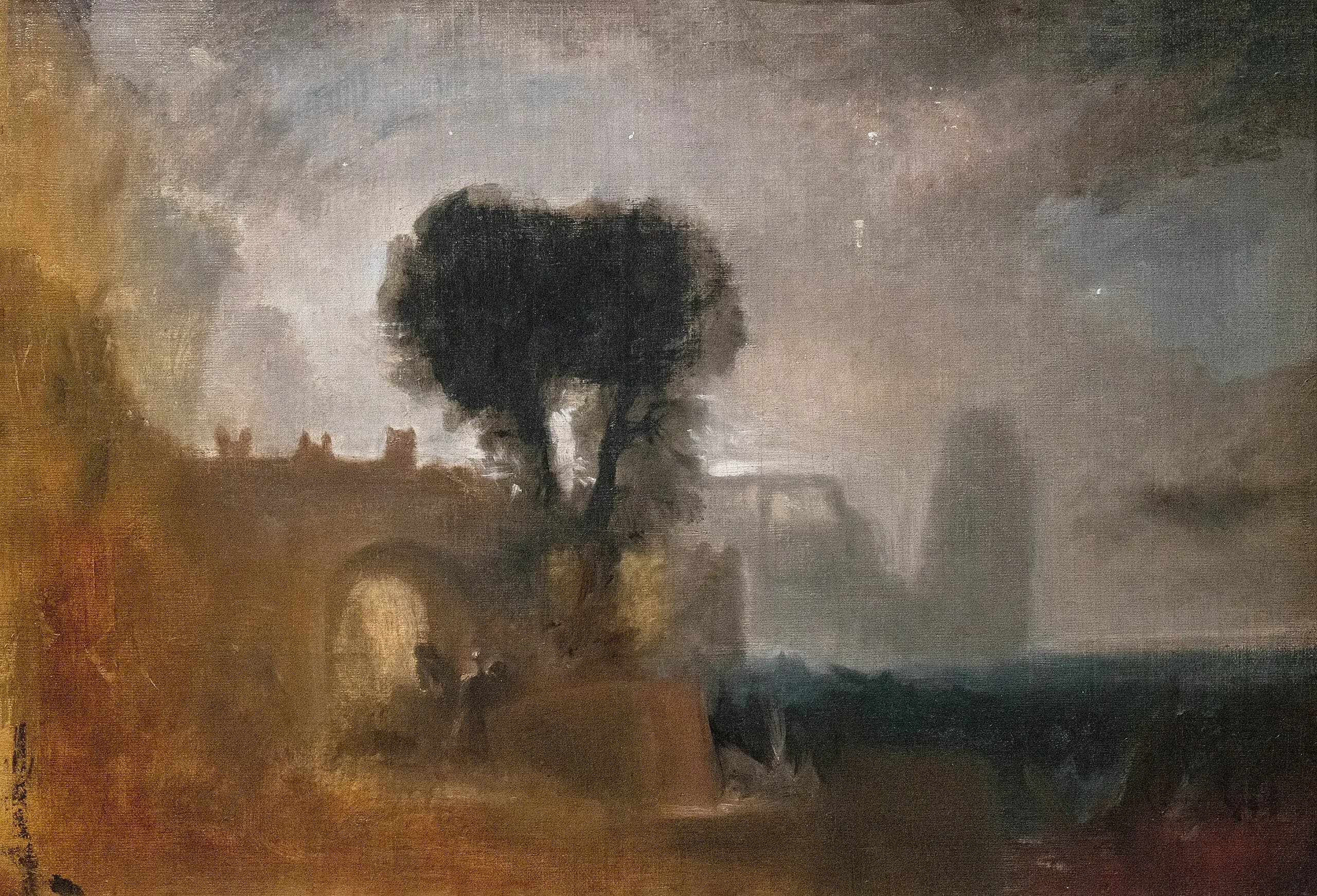
Archway with Trees by the Sea; Sketch for ‘The Parting of Hero and Leander’
- Original dimensions
- 59.4 x 87 cm
- Museum
- Tate
- Year
- 1827
Scene depicted
This pictorial work captures the essence of an ephemeral moment between man and nature. In the foreground, a majestic arch of greenery seems to invite the viewer to adventure, while in the background, shadows and lights play on the shimmering waves of the sea. The painting evokes an atmosphere of melancholy and wonder, like a passage to a mythological world.
Historical context
Created in 1827, this painting is a precious sketch by the British artist Joseph Mallord William Turner , an iconic figure of Romanticism . The work was conceived in London, a cultural epicenter where Turner found inspiration among the mist of English landscapes. Currently, this canvas is preserved at the Tate museum, in the heart of the British capital, where it continues to move visitors.
Place in the artist's career
Situated between the promising beginnings and the stylized peaks of later years, Archway with Trees by the Sea represents a phase where Turner begins to marry reality and imagination. This canvas echoes other significant works, such as “The Decline of Carthage” and “The Storm,” illustrating his technical evolution and growing emotional depth.
Anecdote
Turner, in a moment of creative inspiration, reportedly said: “Light is the very poetry of painting.” One spring morning, he found his momentum in the softness of light filtering through the trees by the sea, a scene that transforms into a canvas vibrant where dream and reality intertwine.