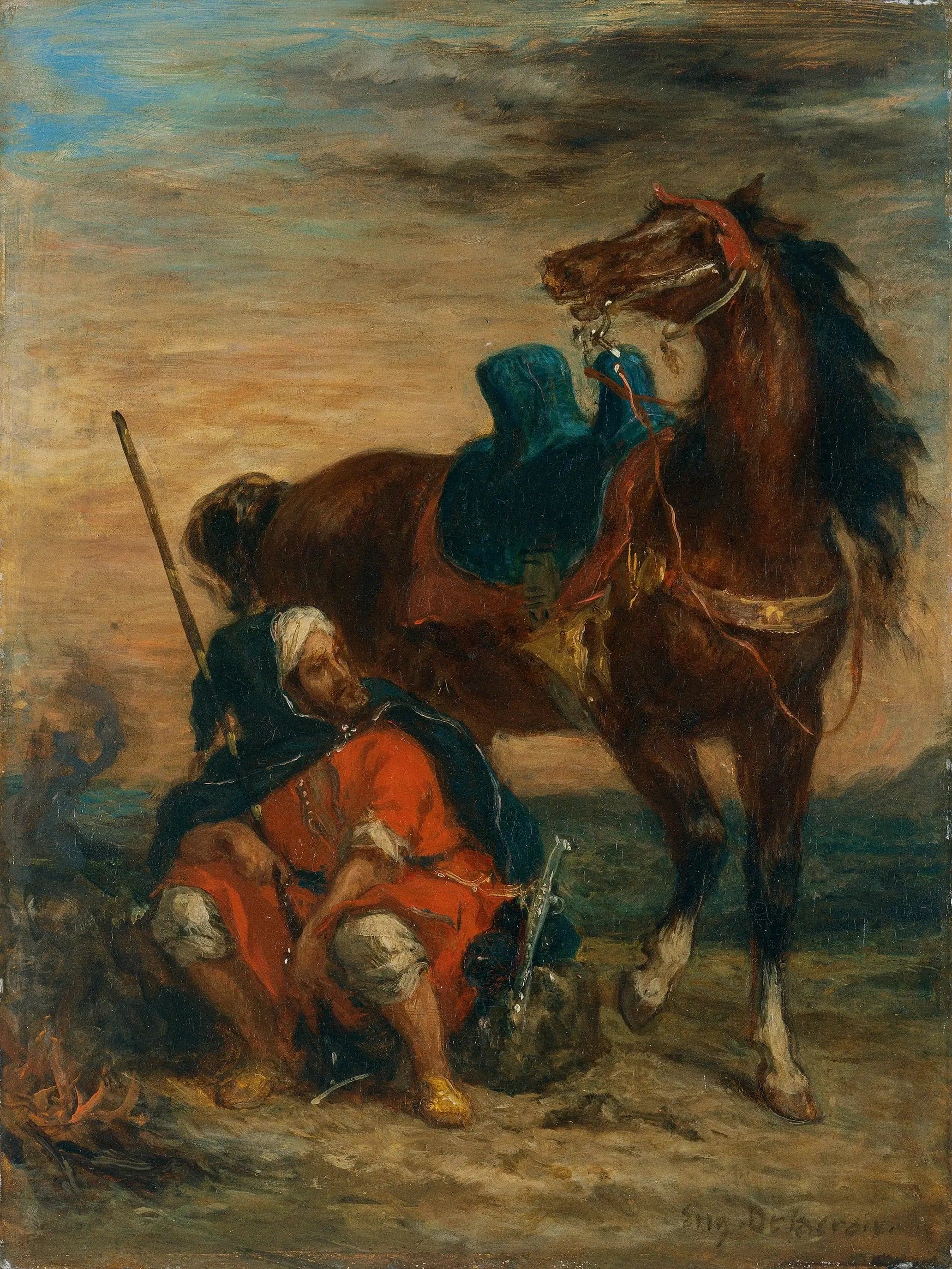
Arab Horseman
- Original dimensions
- 26.5 x 35 cm
- Museum
- Thyssen-Bornemisza Museum
- Year
- 1854
Scene depicted
The painting “Arab Horseman” depicts a man in full motion, on an elegant steed, in a brightly lit setting. The scene exudes immense power and pure beauty. Every detail of the horse and rider, far from being anecdotal, tells a story of heroism and nobility. It is a work that pays tribute to Eastern culture while highlighting Delacroix's technical skill in capturing movement and emotions.
Historical context
Artwork: Arab Horseman |BRK| Artist: Eugène Delacroix |BRK| Year: 1854 |BRK| Museum: Thyssen-Bornemisza Museum |BRK| Dimensions: 26.5 x 35 cm |BRK|
Place in the artist's career
This painting , at the crossroads of youth and expertise, reveals how much Delacroix evolved in his art. A testament to his stylistic peak, it matures alongside two other masterpieces: “ Liberty Leading the People ” and “ The Massacres of Scio .” Each painting reflects a different facet of human passion and suffering, a true emotional and technical progression.
Anecdote
“Art has this sublime quality: it prolongs the invisible, it whispers the dreams of the soul,” said Eugène Delacroix . Inspired by a spring morning in a distant oasis, the master captured the wild elegance of a horseman, an enchanting moment forever etched in the fabric of his pictorial work. Each brushstroke evokes the fervor of time's passage, the allure of exoticism, rekindling the vigor of forgotten emotions.