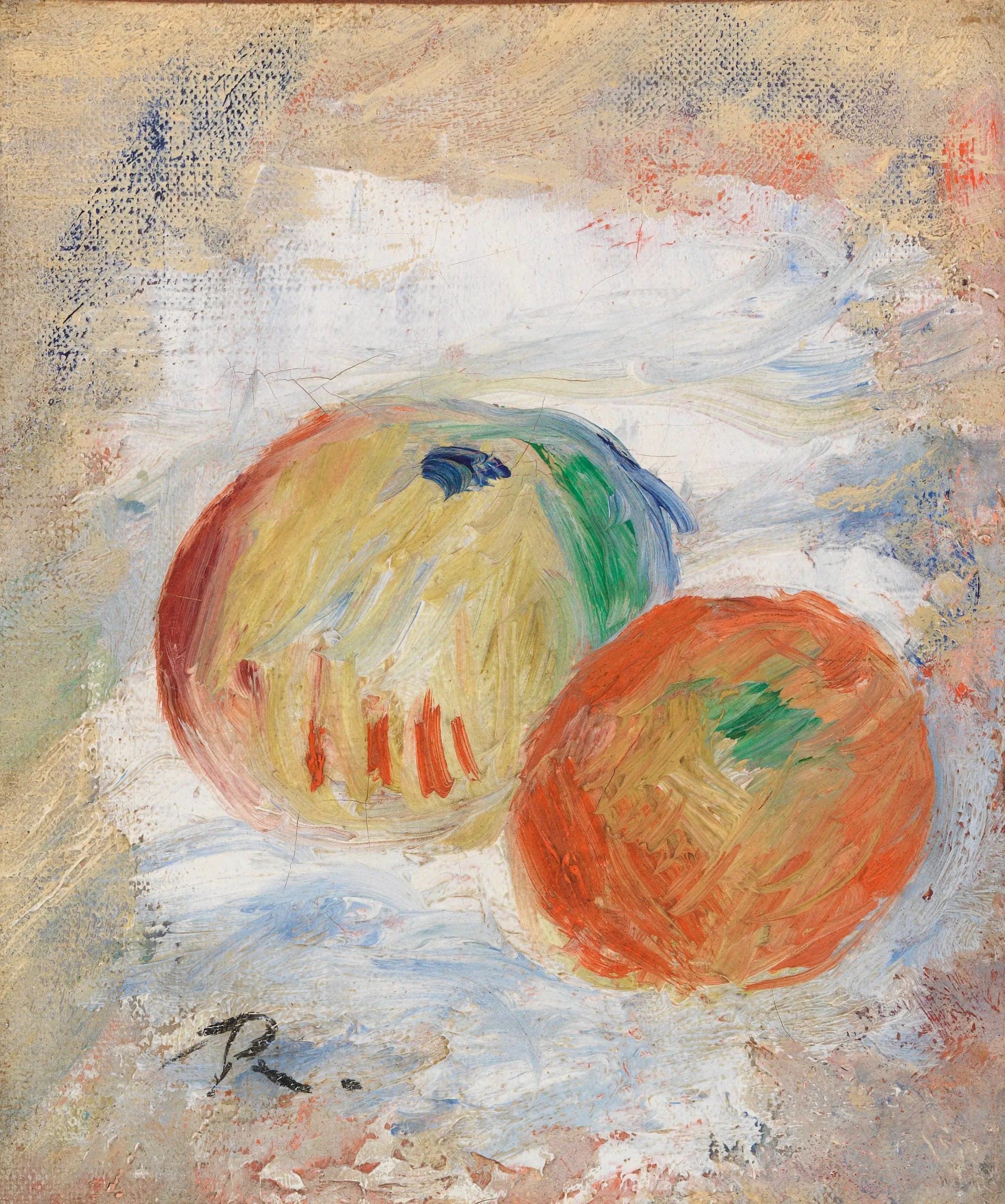
Apples - Pierre
- Original dimensions
- 12.4 x 14.3 cm
- Museum
- Barnes Foundation
- Year
- 1875
Scene depicted
In the painting "Apples," Renoir highlights the simplicity of a daily interlude, offering an ode to nature. The fruits, carefully arranged, seem to echo a changing world, where every hue and shade of the canvas tells a story. The harmonious arrangement and richness of textures suggest a sensory closeness, almost tangible.
Historical context
Created in 1875, during a Parisian spring vibrant with light, the painting "Apples" is part of impressionism , a movement that redefined art by capturing the ephemeral nuances of everyday life. This canvas emblematic of Renoir finds its place today at the Barnes Foundation , a unique art institution located in Philadelphia, and evokes admiration for both its composition and its technical innovation.
Place in the artist's career
This canvas marks a key milestone in Renoir's career. After his promising debut with pieces like "The Theater Box" and before more complex compositions such as "Luncheon of the Boating Party," "Apples" reveals the evolution of his style towards intimacy in the representation of objects. This masterpiece testifies to a pivotal period when Renoir refined his sensory approach to painting.
Anecdote
"Art is the reflection of human sensitivity." These words from Renoir, one spring morning as he observed his friend's garden, awaken the emotions at the heart of the canvas "Apples." The artist's gaze captured the simple yet striking beauty of the fruits, enhancing their presence through soft light and delicate shadows, thus giving depth to this pictorial work .