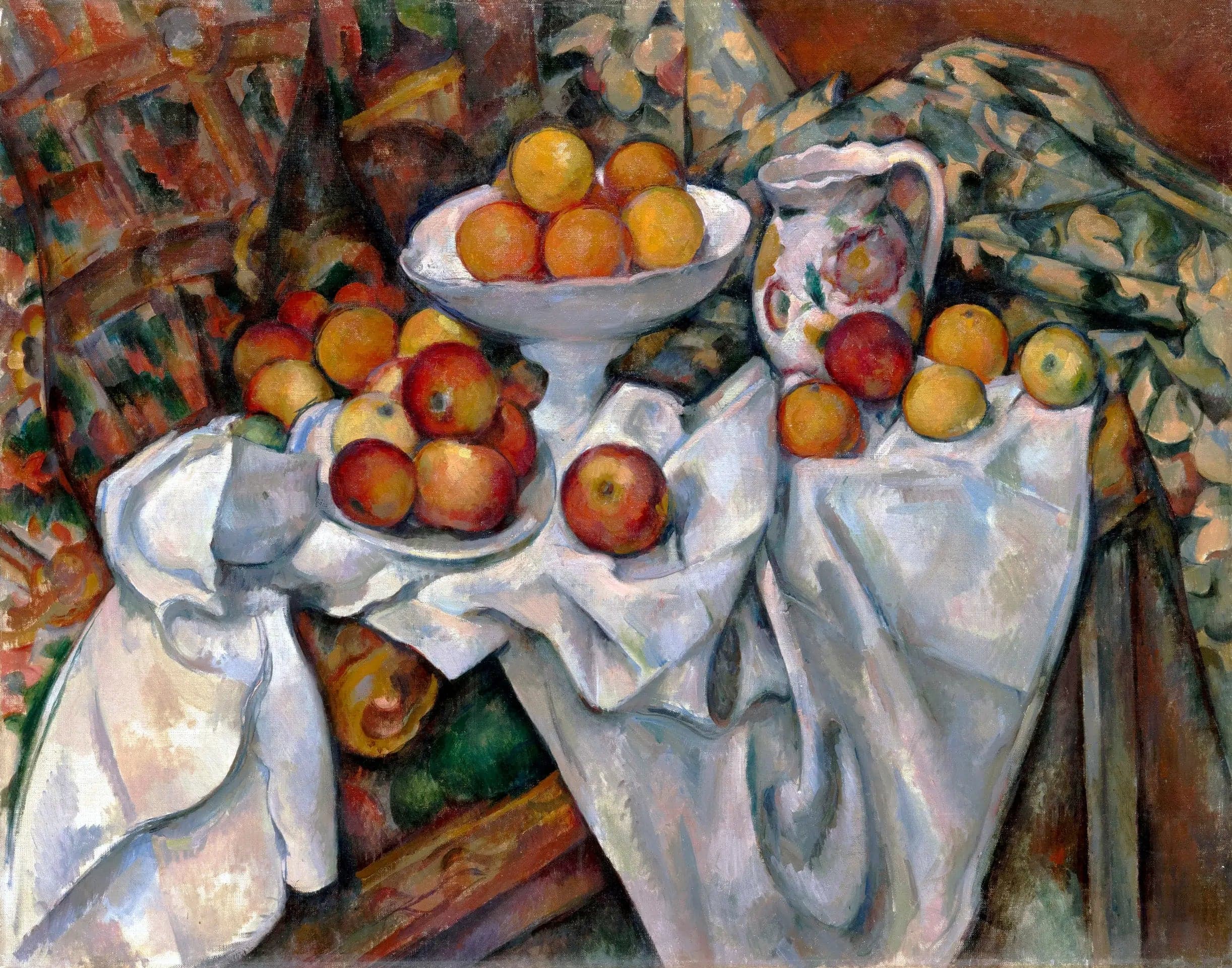
Apples and Oranges
- Original dimensions
- 93 x 74 cm
- Museum
- Orsay Museum
- Year
- 1899
Scene depicted
The composition of Apples and Oranges reveals a still life where the fruits, carefully arranged, become vibrant actors in the scene. With a bright palette, Cézanne invites us to dive into a sensory universe, where the fruity textures seem almost tangible, evoking the sweetness and juicy reality of a festive orchard.
Historical context
Created at the end of the 19th century, the painting Apples and Oranges comes to life in an artistic context marked by Post- Impressionism , a movement to which Paul Cézanne contributed masterfully. This iconic painting, currently exhibited at the Orsay Museum in Paris, unfolds in 93 x 74 cm, and bears witness to a key moment in the history of art, where color and form begin to dissociate from observed realities.
Place in the artist's career
This painting fits into a pivotal period of Cézanne's career, marked by increasing elegance and stylistic development. Like The Large Bathers and The Montagne Sainte-Victoire , Apples and Oranges illustrates his evolution towards subtle abstraction, glorifying form and color beyond imitation.
Anecdote
“I want to paint the universe, the small things and the big ones, everything that surrounds me.” These words from Cézanne resonate with the quest for authenticity that was at the origin of his masterpiece. Imagine a spring morning in Aix-en-Provence, where the light caresses the fruits arranged on a table, inspiring that creative impulse found in the canvas .