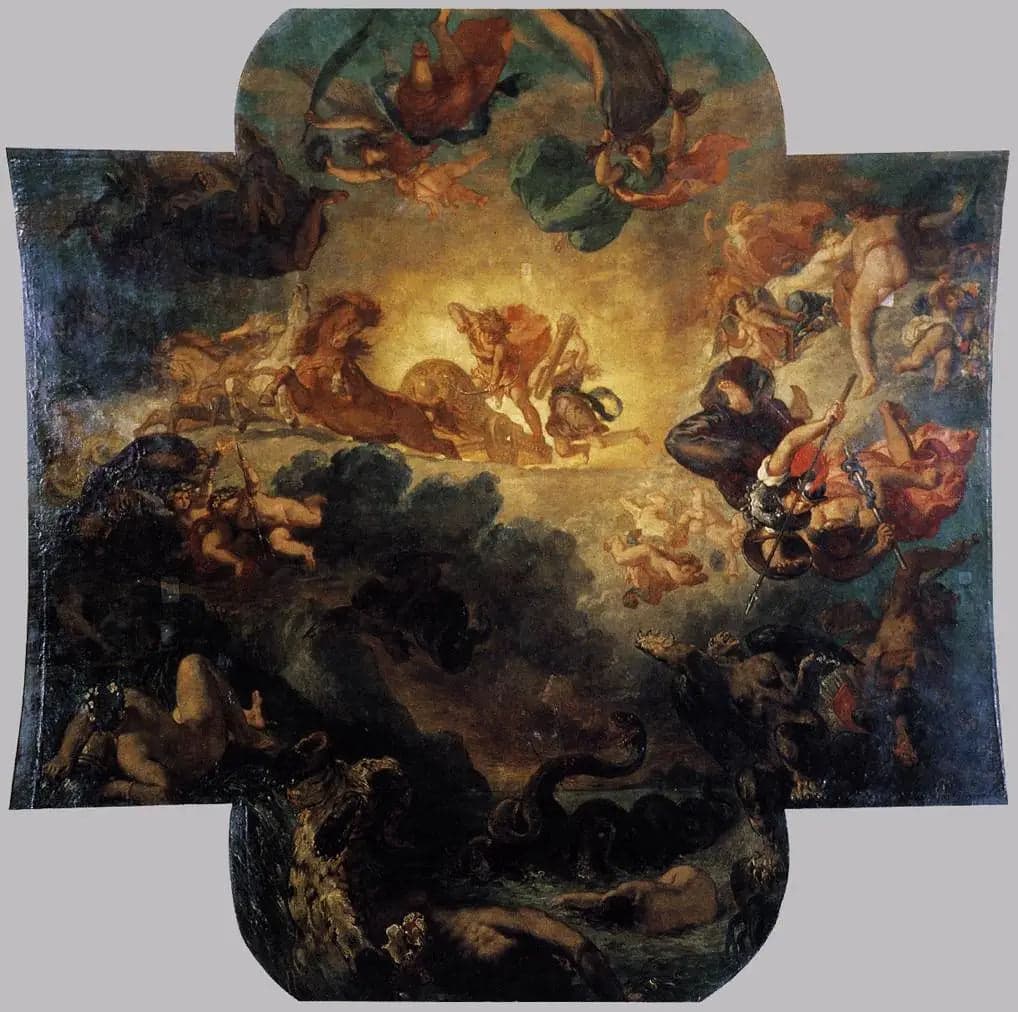
Apollo victorious over the serpent Python
- Original dimensions
- 99.5 x 110 cm
- Museum
- Emil G. Bührle Foundation and Collection
- Year
- 1853
Scene depicted
This painting illustrates the mythological legend of Apollo, god of the arts and knowledge, who triumphs over the serpent Python. The intense and dynamic scene is filled with light and movement. Apollo, the bearer of victory, represents strength and beauty, while Python, dark and threatening, evokes the dark forces to be overcome. This battle between light and shadow is more than just a scene; it is an ode to heroism and determination, animated by the vibrant breath of romanticism.
Historical context
Created in 1853, this painting by Eugène Delacroix is set in the vibrant city of Paris, the heart of the romantic movement, where passion and artistic sensitivity meet a time of upheaval and rebirth. This masterpiece , capturing Apollo's triumph over the serpent Python, is today carefully preserved at the Emil G. Bührle Foundation and Collection , in an exhibition that celebrates the very essence of French romantic painting . The generous dimensions of 99.5 x 110 cm make this canvas a true focal point of admiration.
Place in the artist's career
This painting marks a turning point in Delacroix's career, signifying a period of stylistic maturity. Alongside Liberty Leading the People and The Massacre of Chios , this painting testifies to an evolution towards increasingly theatrical and emotional compositions. It is then that his style reaches a lyrical continuity, solidifying his role as the undisputed master of romanticism.
Anecdote
“Light is the soul of painting ,” said Delacroix, inspired by a gentle morning bathing his studio in light. It is in this delicate atmosphere that he sketched the outlines of his iconic painting . The echo of footsteps on the cobblestone streets, the scent of blooming lilacs, and the song of birds guided him towards this pictorial work , a reflection of an eternal struggle between good and evil.