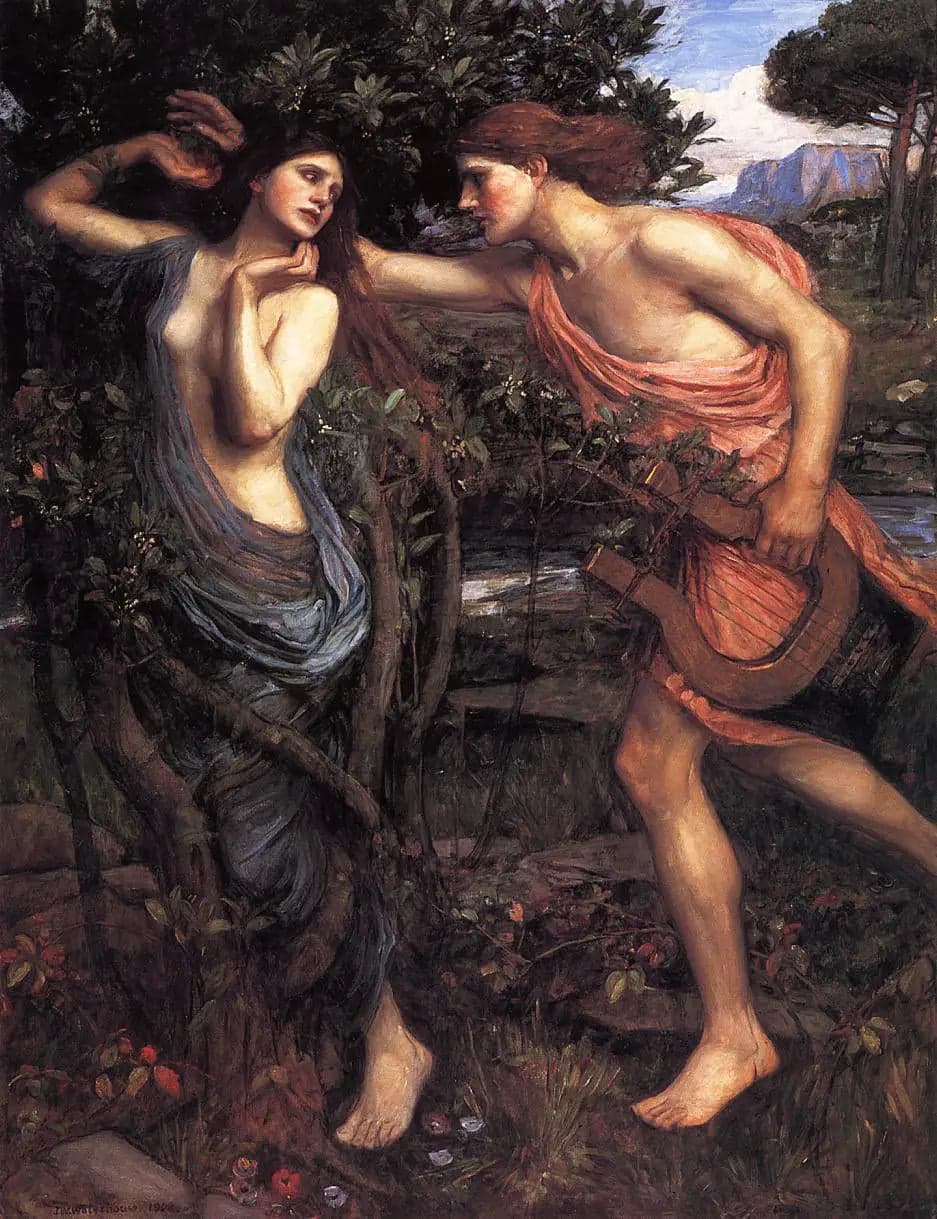
Apollo and Daphne
Scene depicted
This painting illustrates Greek mythology, depicting the god Apollo pursuing the nymph Daphne who desperately seeks to escape his passion. The palpable tension between desire and flight is manifested by the dynamic movement of bodies and drapery in the breath of the wind. Daphne's transformation into a laurel tree symbolizes the eternity of their tragic and unrequited love story.
Historical context
Created in 1891 in London, this iconic work belongs to the Pre-Raphaelite movement, an artistic movement that advocates a return to the stylistic and thematic values of art before the Renaissance . Currently, the original painting is displayed at the Royal Academy of Arts in London. The dimensions of this masterpiece are 106.7 cm by 76.2 cm.
Place in the artist's career
Apollo and Daphne represents a pinnacle in Waterhouse's career. This masterpiece is part of a period of maturity, marked by an unparalleled mastery of painting . In parallel, works such as The Guardian of the Grail and The Sirens demonstrate his technical evolution, embellishing each of his narratives with light, themes of desire, and harmonious composition.
Anecdote
John William Waterhouse once stated: “Beauty is not just to be seen, but to be felt.” It was during a walk in the lush gardens of London that he found inspiration to create this canvas , soaking in the delicate fragrances of spring flowers, captivating his mind. This moment encapsulates the essence of Apollo and Daphne as a dance between light and shadow, passion and despair.