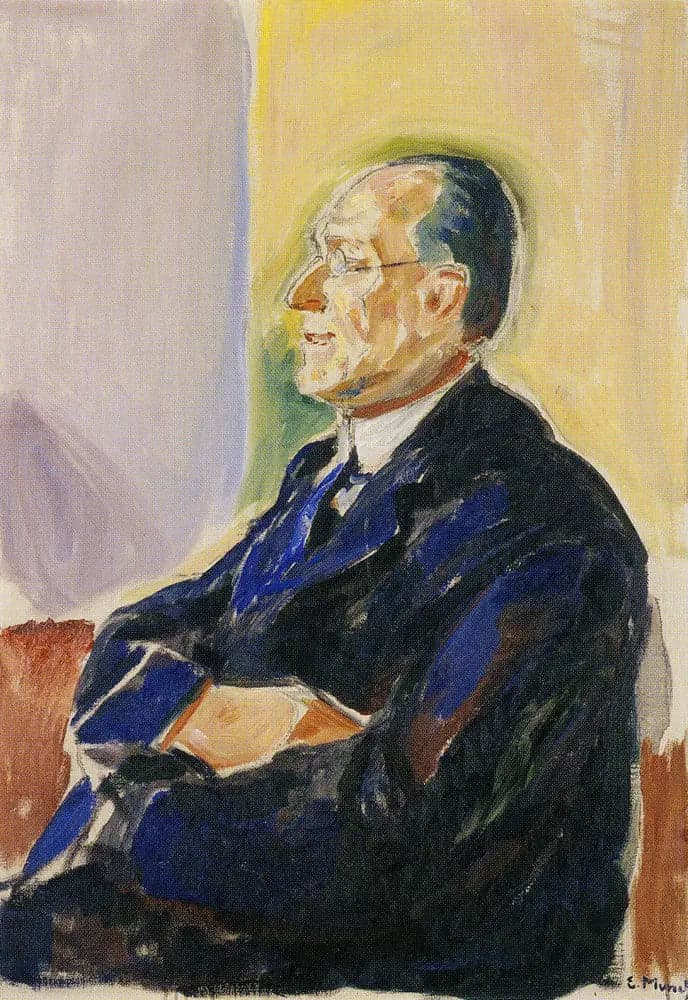
Anton Brünings
- Original dimensions
- 76 x 106 cm
- Museum
- "degenerate art" collection
- Year
- 1919
Scene depicted
In this painting , Edvard Munch depicts the portrait of Anton Brünings, a man lost in thought, where melancholy is expressed through marked features and intense light. The composition, charged with emotion, captures a suspended moment, revealing the inner turmoil of the human soul. Munch, through his unique gaze, indicates that behind every face lies a complex and poignant narrative.
Historical context
Created in 1919, in the tumultuous context of the post-war period, the painting by Edvard Munch , Anton Brünings, is rooted in expressionism , a movement that liberates emotions and explores the psychological. Currently preserved in the "degenerate art" collection, this iconic work testifies to a time when creativity was both a revolt and a quest for identity. These dimensions (76 x 106 cm) make this painting a striking piece, both imposing and intimate.
Place in the artist's career
“Anton Brünings” is at the heart of Edvard Munch 's career, symbolizing a phase of artistic maturity. While works such as “The Madonna” and “The Scream” mark essential milestones in his evolution, this painting reveals his talent for capturing human fragility. This period crystallizes his unique style, amalgamating emotional intensity and visual innovations.
Anecdote
“Every portrait is a voice that sings, a story to tell.” Edvard Munch always found his inspiration in the subtleties of everyday life. Imagine him on a sunny morning, wandering the streets of Oslo, observing a young man, Anton Brünings, whose troubled soul resonates within him. This encounter inspired a pictorial work that still resonates today, infusing a deep emotional life into every brushstroke.