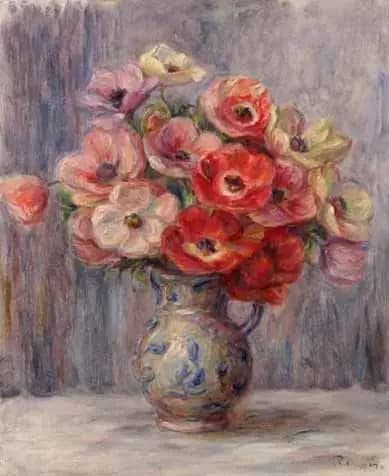
Anemones - Pierre
- Original dimensions
- 32 x 25 cm
- Museum
- Museum of Arts of Nantes
- Year
- 1900
Scene depicted
In this pictorial work, Renoir magnifies the ephemeral grace of the anemones, exploring fleeting beauty under soft lighting. Each delicate flower reveals itself in a harmony of colors, as if time has stopped to appreciate their brilliance. The composition evokes a symphony of sensations, transporting the viewer into a peaceful atmosphere, where the everyday is adorned with magic.
Historical context
Created in 1900, in the heart of the Impressionist era, this painting is set in a revolutionary artistic context, where the use of light and colors often undergoes a bold transformation. This enchanting canvas , carefully preserved at the Museum of Arts of Nantes , evokes the deep connection that unites the artist with nature, an emblematic characteristic of his work, at a time when Impressionism truly takes off.
Place in the artist's career
Considered a significant milestone in Renoir's career, The Anemones represents a transition towards stylistic maturity. This canvas , alongside other works like The Bathers and The Girls of the Rue de la Vieille-Duchesse , marks the emergence of Renoir as a master of the interaction between light and color, a true testament to his artistic evolution.
Anecdote
“Nature is a masterpiece in itself.” This quote from the master Impressionist resonates in every brushstroke of this painting . Imagine Renoir strolling in his garden, enveloped by the sweet scents of flowers, on a spring morning where the anemones dance under the caresses of the wind. This moment of inspiration becomes a creative force, capturing the very essence of life through this canvas .