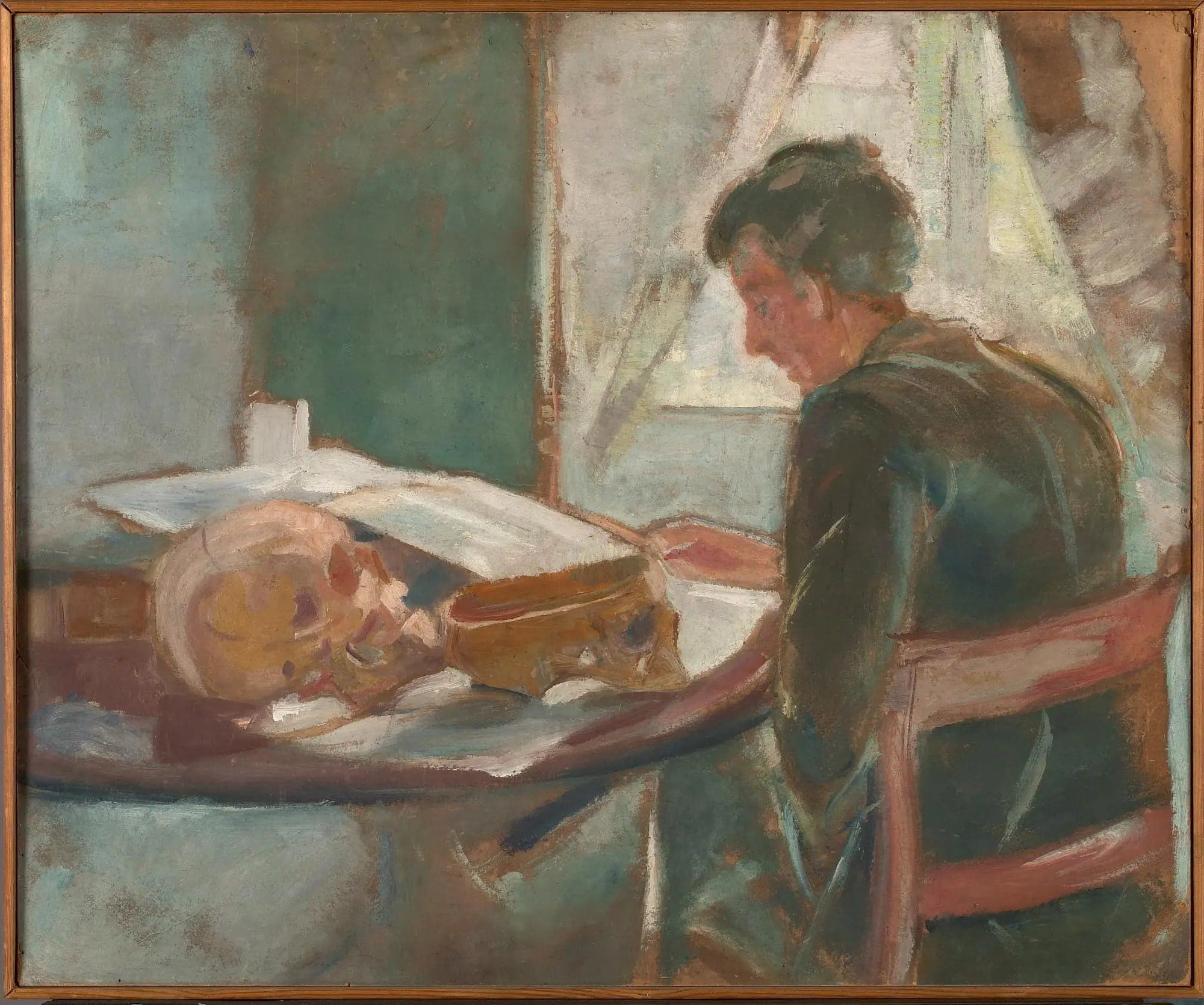
Andreas Munch studying anatomy
- Original dimensions
- 74.5 x 62 cm
- Museum
- Munch museum
- Year
- 1886
Scene depicted
In this masterpiece, Munch captures a moment of intense contemplation: a student immersed in the study of forms and shadows, representing a transition between life and death. This pictorial composition is a tribute to scientific learning while being imbued with poignant emotion, revealing the doubts and aspirations of youth.
Historical context
Created in 1886, this painting takes place in the artistic context of the late 19th century, a period marked by the emergence of symbolism and modernism in Oslo, Norway. The painting, currently exhibited at the Munch museum, evokes the concerns of the time regarding human anatomy and the human condition itself, while savoring the colors and shapes characteristic of this artistic period.
Place in the artist's career
This painting marks a crucial milestone in Munch's career, leading him to explore recurring themes in his future work. Alongside works like "The Scream" and "The Madonna," "Andreas Munch student in anatomy" highlights Munch's evolution towards a more personal and emotional expression, where each painting becomes a mirror of his own torments.
Anecdote
Edvard Munch once declared: “Art must be a cry, a struggle for existence.” This cry resonates through every brushstroke of this canvas , painted in the light of an autumn morning, where the artist, sitting in the silence of an anatomy room, was struck by the tragic beauty of human life, the depth of medical knowledge.