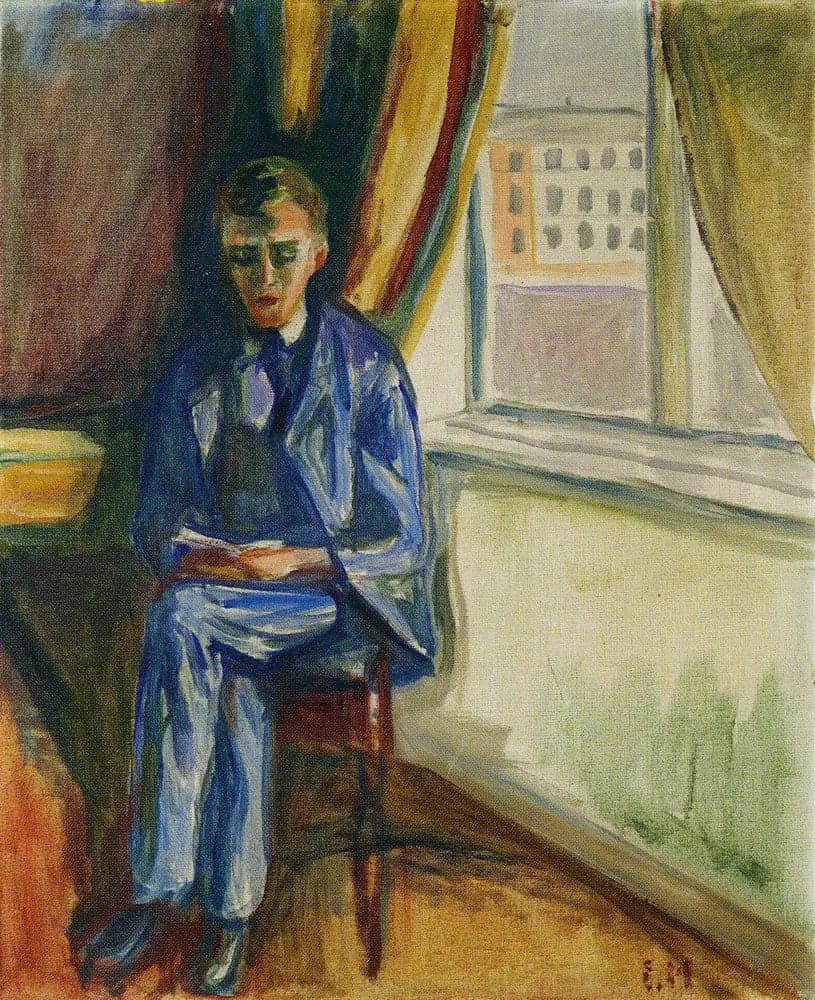
Andreas Lisant
- Original dimensions
- 35.5 x 51.5 cm
- Museum
- National Gallery of Oslo
- Year
- 1882
Scene depicted
The painting depicting Andreas Lisant highlights a moment of contemplation. It shows a man, caught up in his thoughts, gazing at a landscape that holds both beauty and melancholy. The contrast between bright colors and darker shades evokes an introspective atmosphere. The surrounding natural elements seem to live with him, rich in history and feelings, inviting the viewer to share this intimate experience of nature and the human soul.
Historical context
Created in 1882 in the heart of Oslo, this painting is emblematic of the expressionist movement, where Edvard Munch emerges as a prominent figure. In the tumult of the years, during a time marked by personal and social upheavals, the work expresses deep emotions and reflections on human existence. The canvas is currently housed in the National Gallery of Oslo, a cult place for art lovers, offering a perfect setting to appreciate this poetic and emotive composition.
Place in the artist's career
This painting is situated at a crucial turning point in the career of Edvard Munch . Between his early academic studies and his bolder works like “The Scream” and “The Madonna,” Andreas Lisant represents a balance between personal and stylistic exploration. While these later masterpieces unfold a more raw emotional intensity, “Andreas Lisant” focuses on tranquility in contrast to the storm of personal emotions to come.
Anecdote
“The painting must be the cry of souls,” said Munch, evoking the need to translate his inner landscapes onto canvas. Inspired by moments spent in Norwegian nature – between the whispers of trees and the songs of birds – he began to capture the essence of humanity through Andreas Lisant . One summer morning, a light fog floated, enveloping his creative mind and leading him to this poignant vision embodied in the canvas .