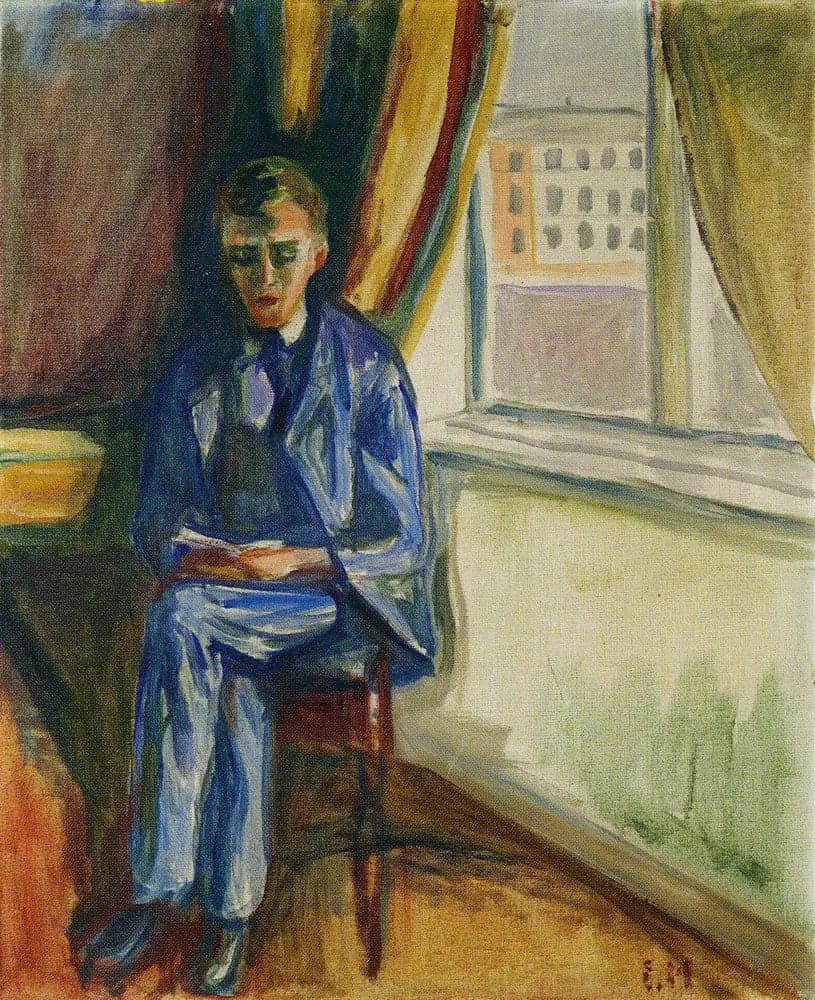
Andreas Lisant
- Original dimensions
- 59 x 73 cm
- Museum
- Not specified
- Year
- 1935
Scene depicted
Andreas Lisant shows a man, lost in his thoughts, contemplating life with an unprecedented intensity. The scene, alluring and mysterious, reveals the complexities of human emotion, oscillating between hope and despair. Munch succeeds in encapsulating this inner struggle with a strong visual language, propelling the viewer into a silent dialogue with the character. The expressionism carried by Munch reaches its peak here, touching on the intimate and the universal.
Historical context
Created in the heart of the 1930s, the painting Andreas Lisant by Edvard Munch captures the essence of an era marked by social and artistic upheavals. This masterpiece emanates from a creativity that was emerging in the Scandinavian landscape, in Oslo, where modern art was asserting itself strongly. Munch, an iconic figure of post- impressionism , explores through this painting deep emotions and universal themes. Although the current location of the painting is not specified, its dimensions of 59 x 73 cm make it a composition of beautiful scale, vibrant with emotion.
Place in the artist's career
This painting , Andreas Lisant , constitutes a centerpiece in Munch's journey, illustrating his period of artistic maturity. In parallel with other works such as The Scream and The Madonna , it shows an impressive evolution, both in technical terms and emotional depth. Munch embraces the chaos of his time while connecting to humanity, a powerful testament to his artistic legacy.
Anecdote
“Art must touch the deepest part of the human soul.” It is in this quest that Munch drew his inspiration for the painting Andreas Lisant . This painting was born one April morning, when, wandering the streets of Oslo, he observed a familiar face, imbued with melancholy. The feeling of solitude and the tragic beauty of that moment then intertwined, forming a vibrant canvas that speaks to the viewer.