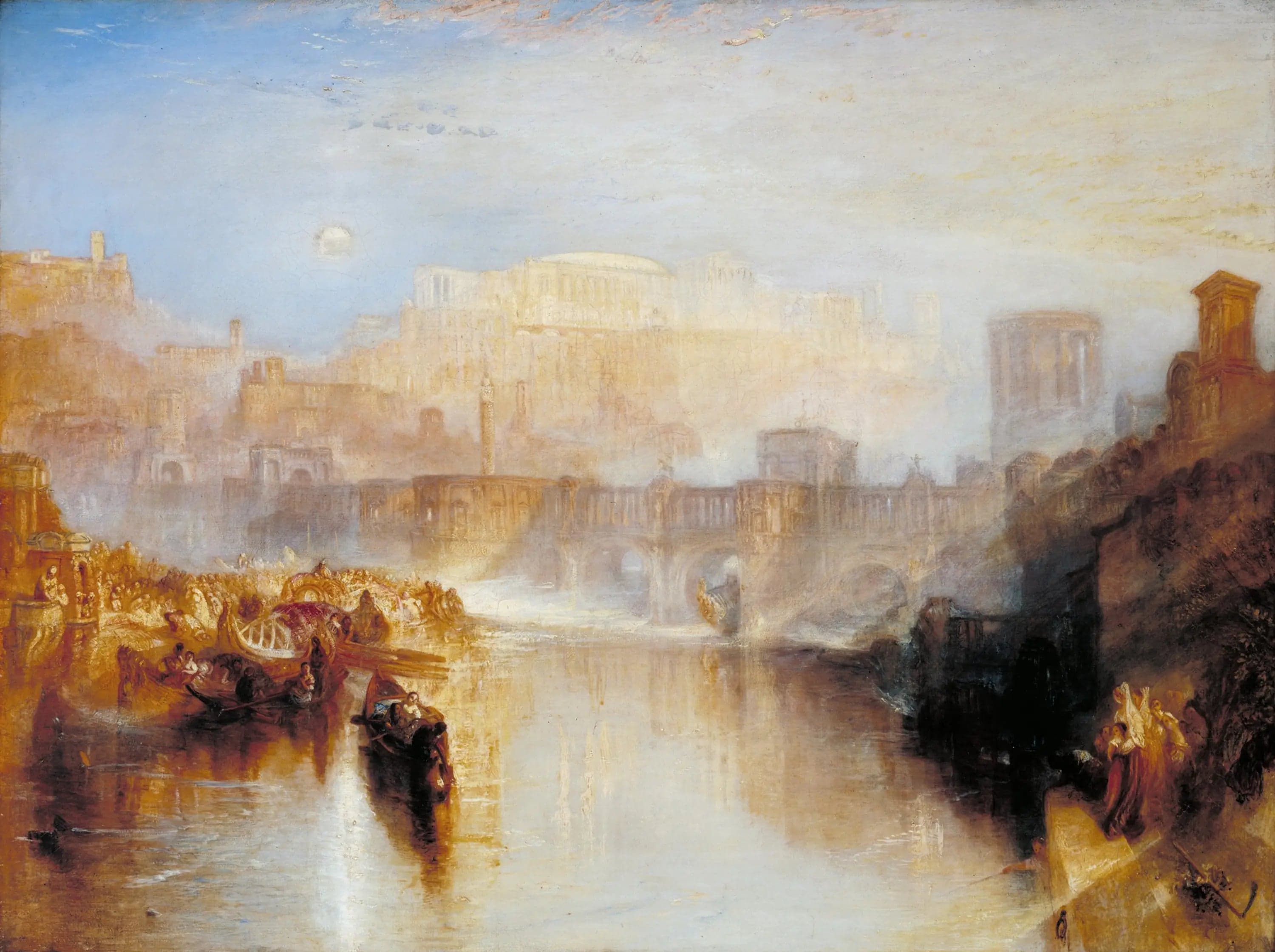
Ancient Rome; Agrippina Landing with the Ashes of Germanicus
- Original dimensions
- 91.4 x 121.9 cm
- Museum
- Tate Britain
- Year
- 1837
Scene depicted
This painting depicts Agrippina, the mother of Emperor Claudius, returning from Exile with the ashes of her deceased husband, Germanicus. The composition illustrates an intimate drama where the pain of loss intertwines with the grandeur of history. The echo of the past and the shadows of its protagonists invite us to reflect on the legacy that memory leaves on our existence.
Historical context
Painted in 1837 and now housed at the Tate Britain , this painting is an iconic work of the Romantic movement, reflecting a rich artistic heritage rooted in London. In a post-Napoleonic context, Ancient Rome; Agrippina Landing with the Ashes of Germanicus explores themes of memory, loss, and nostalgia, capturing a crucial moment in Roman history through the prism of human emotions.
Place in the artist's career
Ancient Rome; Agrippina Landing with the Ashes of Germanicus represents a turning point in Turner’s career, marking his artistic maturity. This painting fits perfectly between "The Storm" and "The Flag of the Empire," revealing an evolution not only in his technique but also in the emotional depth of his works.
Anecdote
Turner is said to have declared: “Every brushstroke must speak to the heart, like a sweet melody.” Inspired by a gentle autumn morning in London, where delicate lights brushed against the fresh air, he found the evocative strength to bring this masterpiece to life. It is this atmosphere imbued with serenity and melancholy that resonates in the canvas .