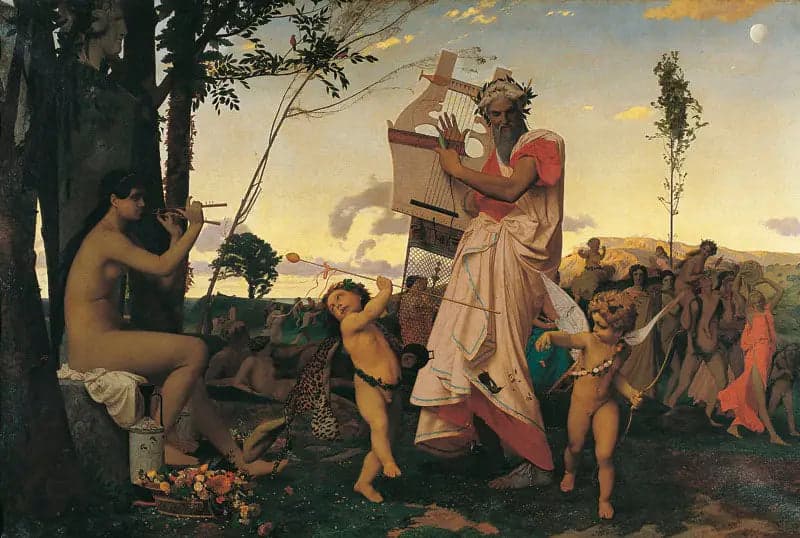
Anacreon, Bacchus and Love - Jean
- Original dimensions
- 211 x 136 cm
- Movement
- academicism
- Museum
- musée des Augustins de Toulouse
- Year
- 1848
Scene depicted
This canvas immerses us in an enchanting mythological tableau, where Bacchus, the god of wine, and Anacréon, the poet associated with the art of celebration, come together in a celebration enshrined in love and music. Gérôme was able to translate the pleasure of the senses through radiant faces, sumptuous drapery, and shimmering colors, creating a festive atmosphere imbued with joy and sweetness.
Historical context
Created in 1848, Anacréon, Bacchus et l'Amour is located in the heart of the city of Toulouse, a vibrant artistic crossroads of ideas. Under the aegis of the academic movement , this painting stands out for its technical mastery and refined aesthetics. The painting finds refuge in the musée des Augustins, where its brilliance and spectacular dimensions of 211 x 136 cm continue to dazzle visitors.
Place in the artist's career
Anacréon, Bacchus et l'Amour represents a turning point in Gérôme's career, marking a stylistic peak. Alongside The Combat of Gladiators and An Oriental Dance , it demonstrates a technical evolution where narrative depth and visual richness reach unprecedented heights, combining storytelling with great expressiveness.
Anecdote
Jean-Léon Gérôme once said: "Beauty lies in the details, it must be observed and celebrated." This sentiment is perfectly embodied in this pictorial work , born from a fleeting inspiration, captured one morning in a garden of exquisite flowers where sweet scents mingled with the gentle breeze, invited to paint the divine Bacchus and Anacréon, symbols of love and passion.
Major exhibitions
Salon de 1848