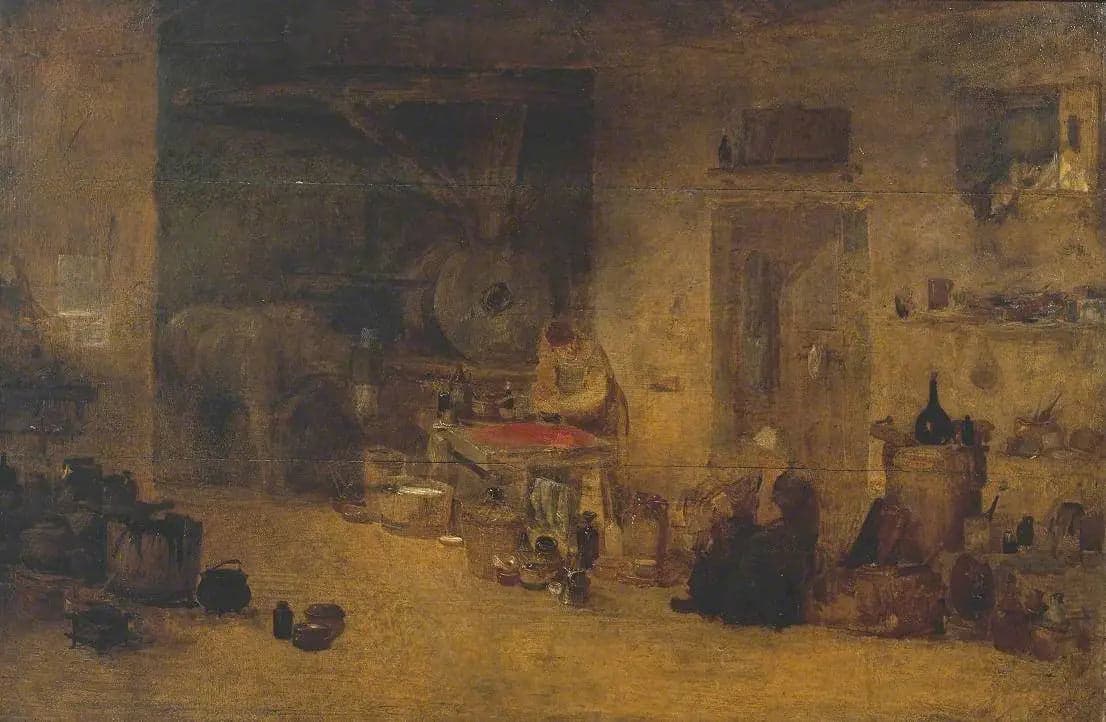
An Artists’ Colourman’s Workshop
- Original dimensions
- 62.2 x 91.4 cm
- Museum
- Tate
- Year
- 1807
Scene depicted
The scene depicts a vibrant workshop, where light plays a central role, illuminating a multitude of colors and artistic materials. The work evokes the harmony between the artist and his environment, a place where pigments become the notes of a visual symphony. Each element of this canvas reinforces the idea that artistic creation is both an act of passion and connection.
Historical context
Created in 1807, this painting is now housed in the famous Tate museum in London. Turner, an iconic figure of the British romantic movement, captures the essence of a time when art turned towards nature and emotions. This canvas is an integral part of the artistic turning point of the early 19th century, illustrating the rise of the impressionism to come.
Place in the artist's career
This canvas marks a key moment in the career of Joseph Mallord William Turner , reflecting his mature style, where light and color take precedence over form. Compared to his other canvases such as “The Snow Storm” and “The Move of Mr. gente’s House,” one observes an evolution towards increasingly bold compositions, seeking to capture the very essence of human experience.
Anecdote
“Light, this source of life, reveals the soul of colors” Turner might have said under a golden sky on a spring morning, as he drew inspiration from his surroundings. The workshop of a colorist, where the scents of fresh pigments dance in the air, shaped the vision of this masterpiece , a canvas vibrant with life and energy.