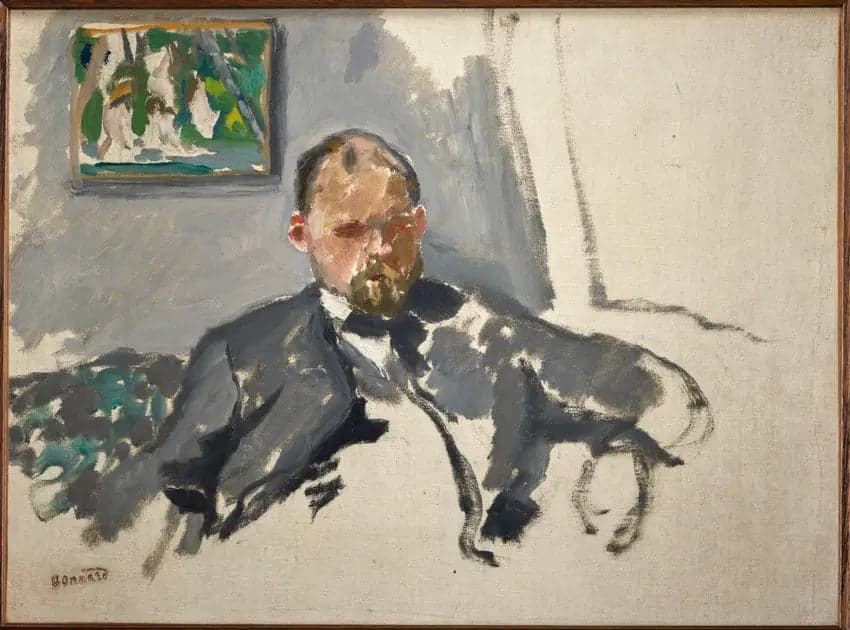
Ambroise Vollard
- Original dimensions
- 60 x 73 cm
- Museum
- Foundation and Collection Emil G. Bührle
- Year
- 1904
Scene depicted
The canvas “Ambroise Vollard” captures the depth of the relationship between the artist and his model. The composition, subtle and textured, evokes an atmosphere of capturing the moment, where the delicate features of the publisher's face blend with the warm hues of the canvas. Through this pictorial work, Bonnard offers a penetrating glimpse into the soul of his subject, revealing not only a portrait but a silent conversation between the painter and his gaze.
Historical context
This painting emblematic, created in 1904, is set in a bubbling artistic context of the Belle Époque in Paris, where Impressionism evolves towards a bolder palette and a more intimate composition. It is in Geneva, within the Foundation and Collection Emil G. Bührle , that this canvas is preserved, a place conducive to discovering this masterpiece whose dimensions gently settle into the space of contemplation.
Place in the artist's career
The painting “Ambroise Vollard” is situated at a turning point in Bonnard's career, illustrating his transition to a more introspective approach. Compared to “La Terrasse à Vernon” and “Déjeuner sur l’herbe,” this canvas reveals a significant evolution, moving from a celebration of nature to an exploration of human relationships, reflecting an artist in search of the essential.
Anecdote
“Art is the revelation of hidden emotions.” Pierre Bonnard drew inspiration from the small pleasures of everyday life. Imagine him on a sunny morning, strolling through the streets of Paris, crossing paths with a man of letters, Ambroise Vollard, a significant encounter that may have suggested to him the eternal beauty he would capture in the painting . A thrill of inspiration that marries the new emotion conveyed by his canvas .