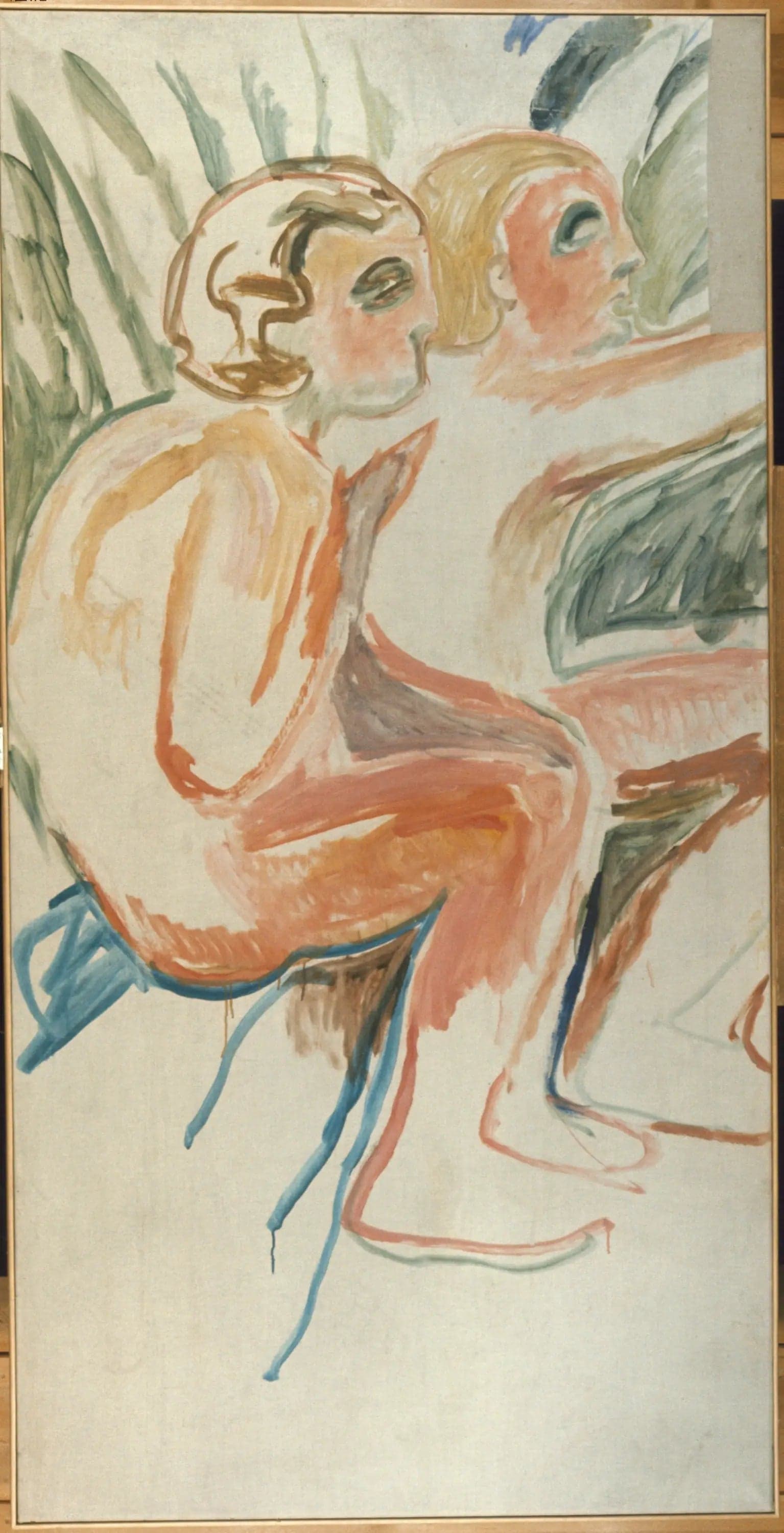
Alma Mater: two children sitting
- Original dimensions
- 97 x 190.5 cm
- Museum
- Munch Museum
- Year
- 1914
Scene depicted
This tableau depicts two children, comfortably seated on the grass, lost in their dreams and games. The scene exudes an atmosphere of serenity and lightness, evoking the simple happiness of childhood. Munch, through his unique style, manages to capture not only an image but also an emotion, transforming a mundane moment of everyday life into a true pictorial work of striking depth.
Historical context
Created in 1914, in Oslo, this painting perfectly illustrates the expressionist movement of which Edvard Munch is one of the pioneers. Deeply rooted in the social and emotional tensions of its time, this canvas is currently housed in the Munch Museum, where it continues to move and fascinate visitors. With its imposing dimensions, this tableau holds a prominent place among the most significant works of the early 20th century.
Place in the artist's career
“Alma Mater: Two Children Sitting” is situated in Munch's maturity period, where his work reaches a profound emotional introspection. Like his other tableaux such as “Melancholy” and “The Scream,” this work shows a marked technical evolution characterized by simplified forms and vibrant colors, reflecting a desire to capture the authenticity of human emotions.
Anecdote
“In the simplicity of children, I see the reflection of lost innocence.” These words from Edvard Munch , often rooted in his artistic vision, evoke the genesis of his masterpiece . Inspired by a fleeting moment of a sunny day, he captured the essence of childhood happiness, thus engraving the image in his memory to transcribe it onto the canvas .