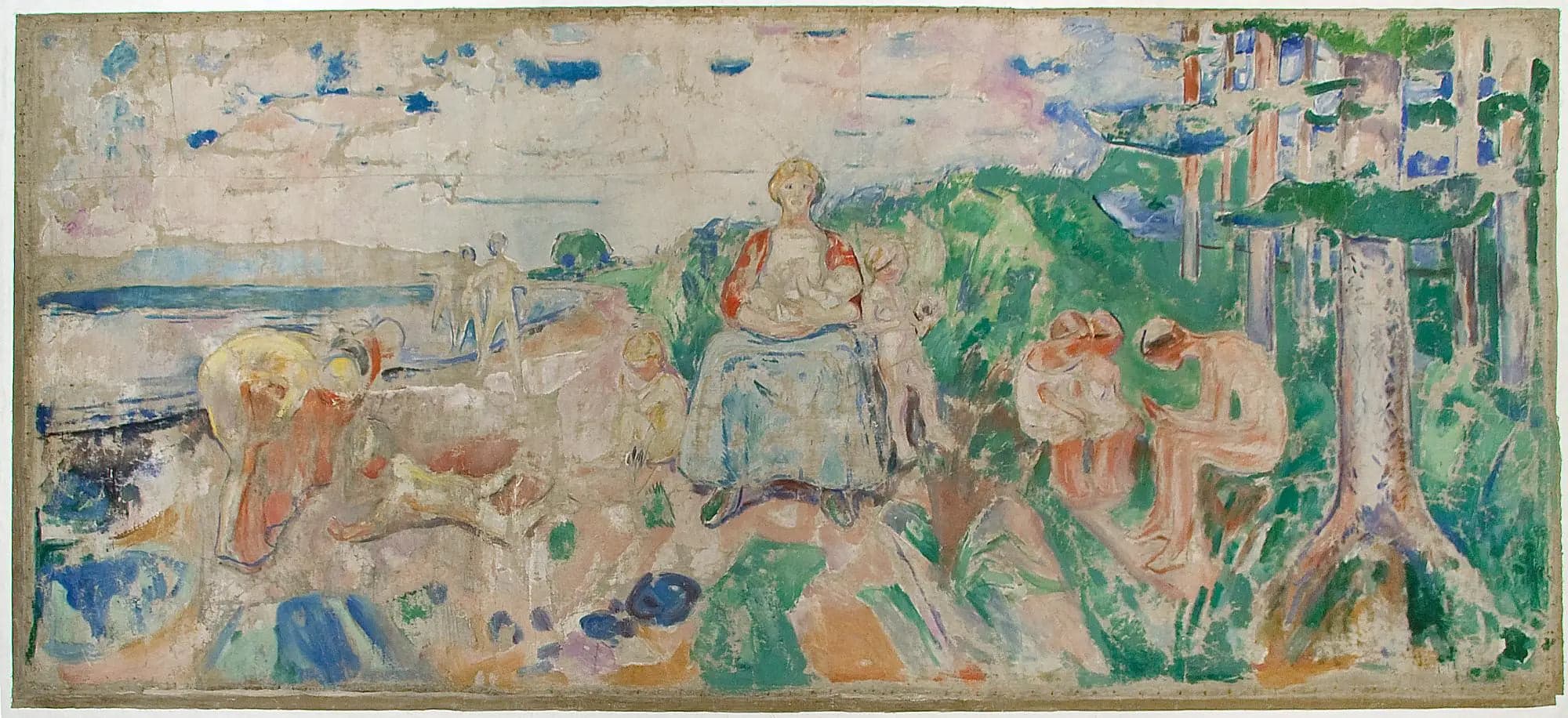
Alma mater
- Original dimensions
- 227 x 99 cm
- Museum
- Munch Museum
- Year
- 1940
Scene depicted
The painting “Alma mater” depicts a mother and her child in a moment of tenderness. Munch captures this sacred relationship with emotional intensity, evoking childhood memories, softness, and protection. This masterpiece speaks of unconditional love and the connection between generations, revealing the very essence of the family bond.
Historical context
Created in 1940, in Oslo, this painting is part of the expressionist movement of which Munch is one of the masters. In a Europe shaken by upheavals, Alma mater reflects the suffering and quest for authenticity of a troubled time. Today, this canvas rests in the Munch Museum, a true sanctuary of human emotions captured by the painter, offering an artistic reading at the heart of Norway.
Place in the artist's career
This painting , from a period of maturity in Munch's career, stands between other iconic creations such as “The Scream” and “The Madonna.” In these paintings, similar explorations of the human condition can be found, but Alma mater stands out for its softness and intimacy, reflecting a stylistic evolution towards a more subtle introspection.
Anecdote
“Inspiration arises when silence prevails.” With these words, Munch described his moment of artistic awakening. Imagine him, one spring morning, walking the streets of his hometown, feeling the ambiance of vibrant nature, as his mind awakened to the beauty of everyday life, giving birth to this masterpiece.