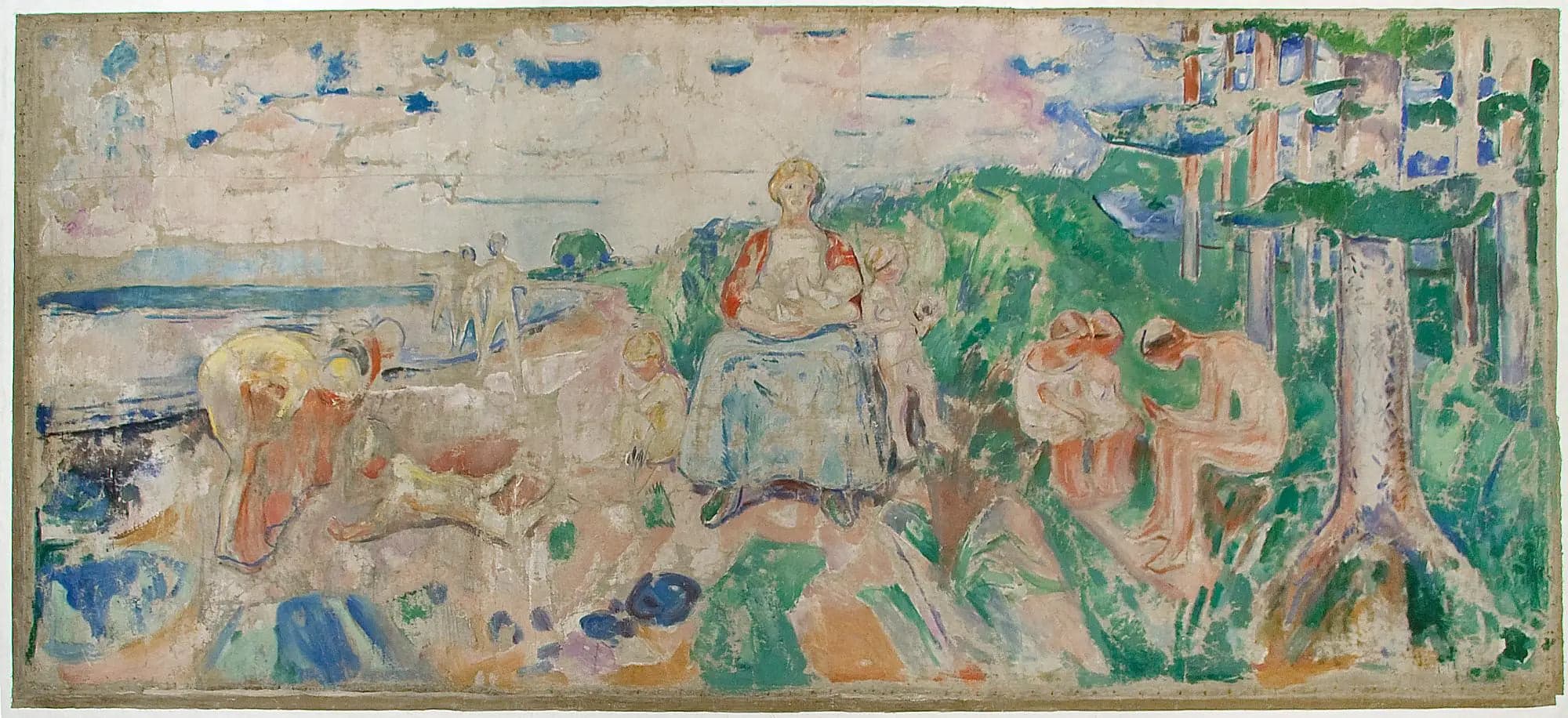
Alma mater
- Original dimensions
- 84.24 x 39.07 cm
- Museum
- Munch Museum
- Year
- 1929
Scene depicted
"Alma mater" explores the universal theme of motherhood, a grace imbued with tenderness and complexity. On the canvas, stylized forms and vibrant colors intertwine to express a deep connection between generations. The composition depicts the mother as a central figure, embodying the life, love, and infinite tenderness that unites mother and child.
Historical context
Created in 1929, the painting "Alma mater" by Edvard Munch is rooted in an artistic context marked by expressionism . This movement, which embraces emotions, pushes the artist to transcend the simple visual to evoke deep feelings. The painting, exhibited at the Munch Museum in Oslo, unfolds on a canvas of pronounced dimensions, capturing the essence of a complex era.
Place in the artist's career
In the career of Edvard Munch , "Alma mater" represents not only an achievement but also a transition to more personal themes. This painting is situated between iconic works such as "The Scream" and "The Madonna," showing an evolution in his emotional and technical approach. The maturity of his style asserts itself here, exploring tenderness through softer lines and a soothing palette.
Anecdote
"Maternity, the sweetness and pain of a life": such could be the thought of Edvard Munch during the conception of this masterpiece . One clear morning, flanked by the whispers of spring, he would have found inspiration in the contemplation of a maternal face. This fleeting moment infuses the painting with an unparalleled emotional depth.