Alma mater
- Original dimensions
- 196 x 91 cm
- Museum
- Munch Museum
- Year
- 1920
Scene depicted
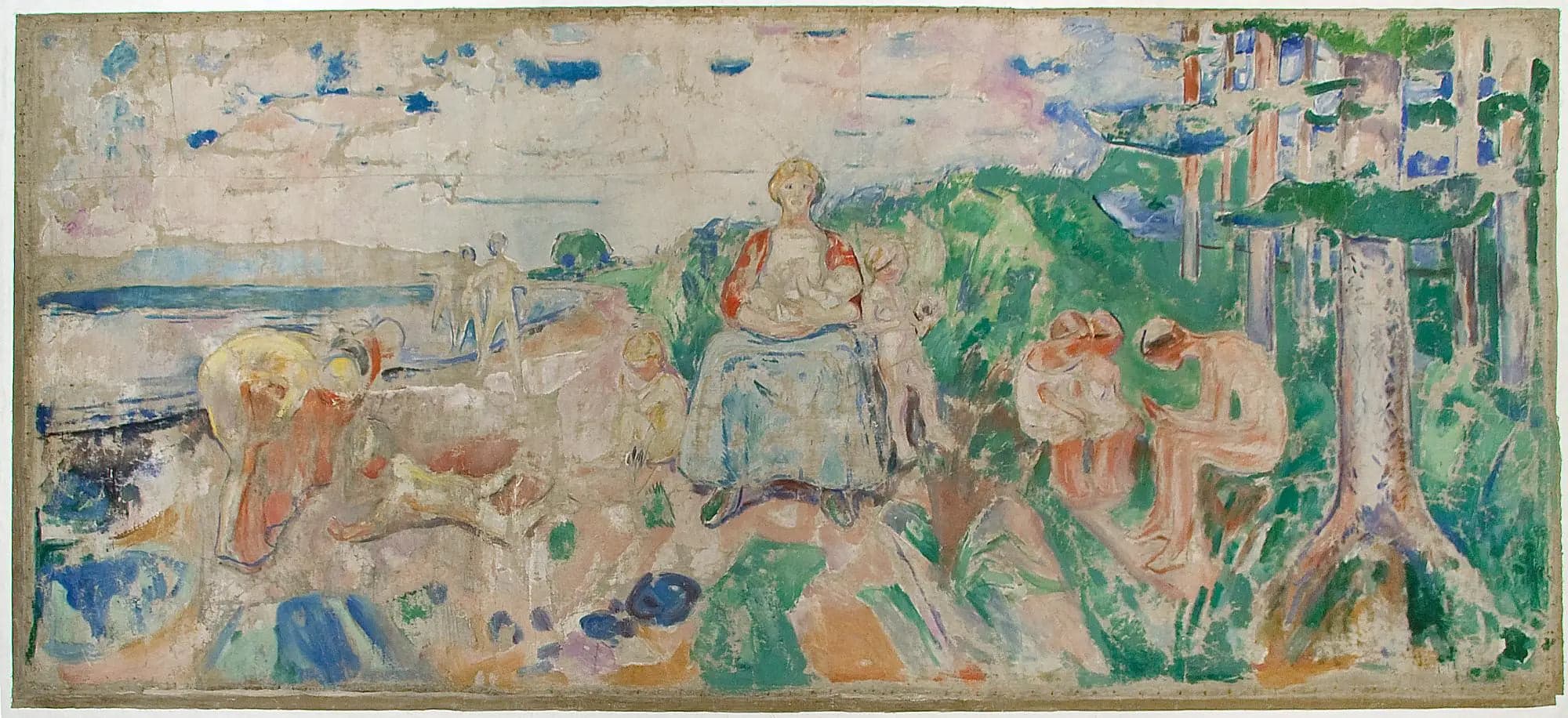
In "Alma mater", Munch delicately captures the essence of the relationship between a mother and her child. The figures intertwine, evoking an intriguing warmth while interpreting the complexity of human emotions. The painting stands as a reflection on life, learning, and love, a pictorial work rich in questioning our own connection with our personal history.
Historical context
Created in 1920 in Oslo, Norway, the painting "Alma mater" is part of the expressionist movement, of which Edvard Munch is one of the leading figures. This painting, currently exhibited at the Munch Museum, reflects a time when the contemplation of the intimate and the tragic became central in art. With its impressive dimensions of 196 x 91 cm, this canvas invites exploration of deep emotions at the heart of its poignant scene.
Place in the artist's career
"Alma mater" is situated at the peak of Edvard Munch's career, marked by a profound stylistic development. Compared to works such as "The Scream" and "Madonna", this painting demonstrates an evolution towards an even more refined introspection. The expressive touch and psychological depth share an obvious link, while highlighting the emotional power that Munch knows how to convey through his canvas .
Anecdote
Edvard Munch once stated: "I paint pictures to help souls rise." Imagine him walking through an alley in Oslo on a gentle spring morning, as his thoughts on motherhood and the vital connection to the past accumulate within him. This painting , "Alma mater", is inspired by this spiritual quest, revealing itself as a vibrant tribute to roots and memories, thus solidifying its essential role in Munch's universe.