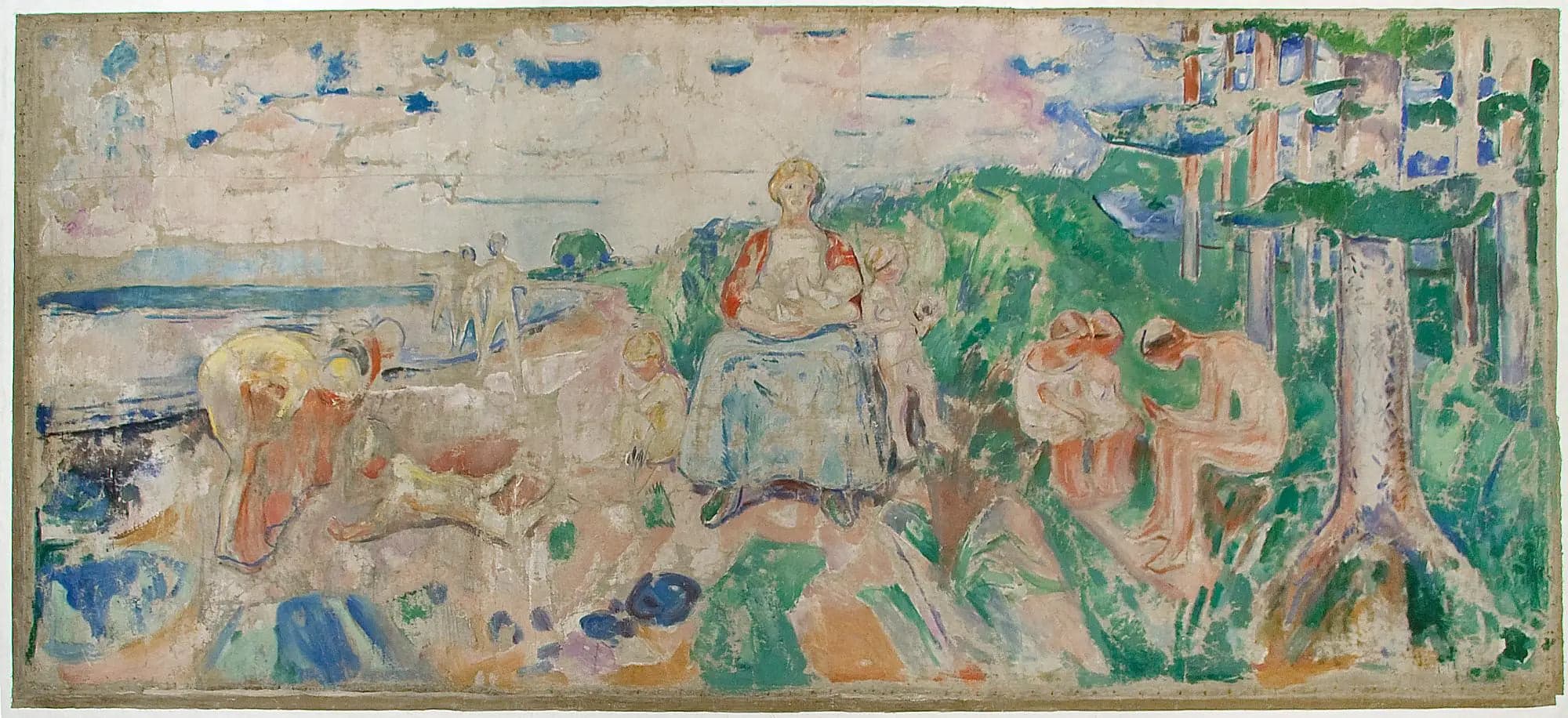
Alma mater
- Original dimensions
- 622 x 265 cm
- Museum
- Munch Museum
- Year
- 1912
Scene depicted
“Alma mater” depicts a captivating emotional landscape: the union between man and nature, the affection and support of a symbolic maternal figure. The composition explores themes of journey and memory, an invitation to reflect on our roots and the relationships that shape us. It is much more than a simple painting ; it is an introspective journey into Munch's world, where every detail suggests a chapter of human history.
Historical context
It was in 1912, in the vibrant city of Oslo, that the painting "Alma mater" was born. Imbued with the expressionist movement, this iconic work reflects a time rich in artistic and social upheaval. The painting is now displayed at the Munch Museum, a sanctuary dedicated to the art of this illustrious creator, preserving this canvas in the imposing format of 622 x 265 cm, inviting the viewer to a striking immersion.
Place in the artist's career
Positioned in the heart of Edvard Munch 's career, “Alma mater” represents a period of maturity where his style is refined. After landmark works such as “The Scream” and “The Madonna,” this painting illustrates a transition to a more subtle expressionism , revealing an increased sensitivity in the use of colors and forms.
Anecdote
“Every brushstroke is an echo of the human soul.” These words from Edvard Munch resonate particularly when considering the genesis of this work. He composed it on a quiet morning, his mind nourished by the echoes of his past, between shadows and lights, thus forging the deep emotions that transcend the painting and touch the truth of existence.