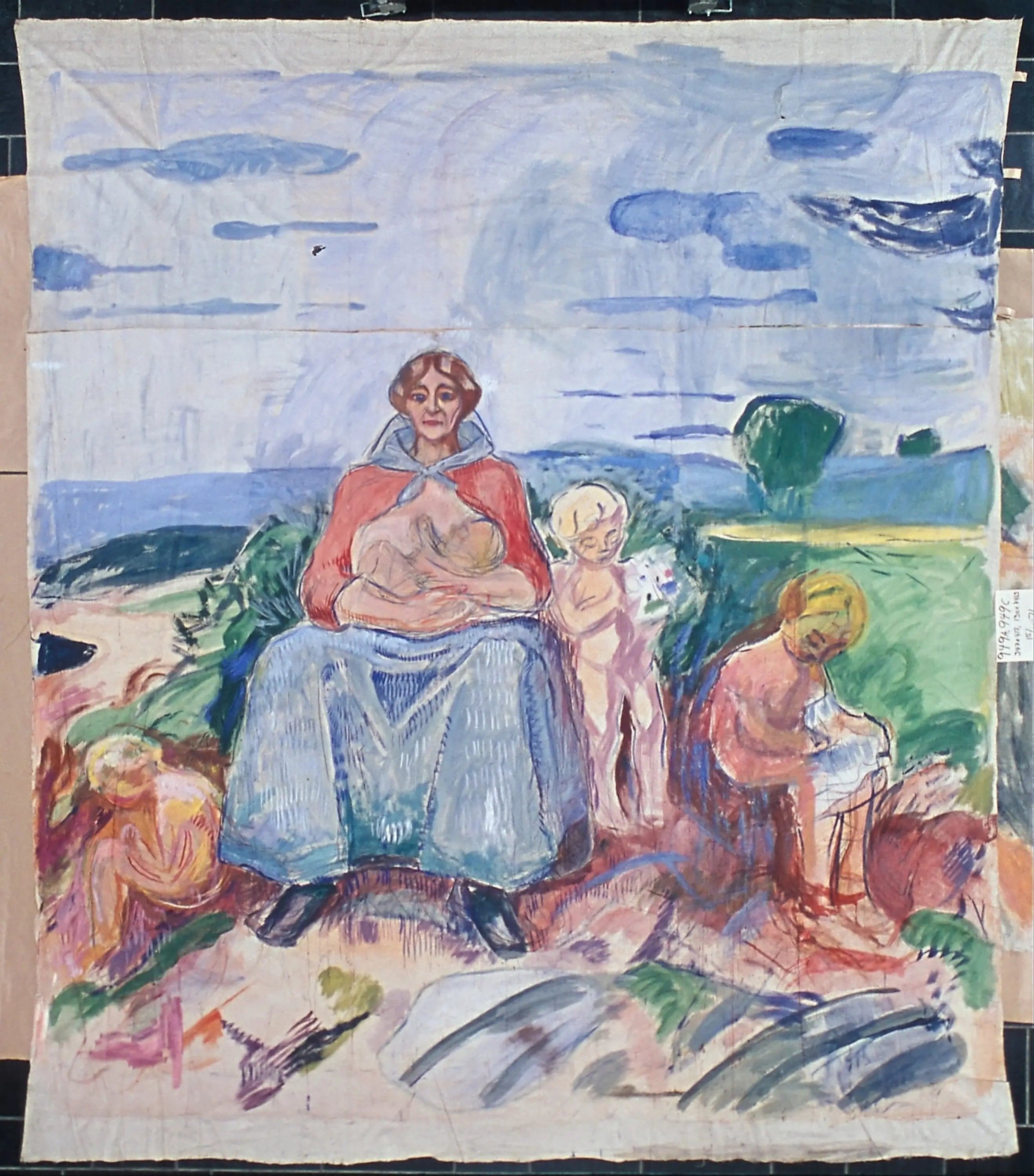
Alma Mater: central part
- Original dimensions
- 207.5 x 450 cm
- Museum
- Munch Museum
- Year
- 1914
Scene depicted
Alma Mater: central part represents the majesty of the educational institution and its impact on the formation of the individual. The protagonists of the canvas are emblematic figures of learning and elevation, each face and posture telling a story of hope and despair, aspiration and memory. Munch explores the complex emotions that arise from the educational experience, suggesting that knowledge is both a gift and a heavy responsibility.
Historical context
Created in 1914 in Oslo, Norway, this painting is part of the expressionist movement, which sought to convey deep human emotions through art. The canvas is currently housed in the Munch Museum, where it is carefully preserved. Its size, 207.5 cm in height and 450 cm in width, imposes a captivating presence, inviting visitors to immerse themselves in Munch's unique emotional universe.
Place in the artist's career
This painting is at the heart of Munch's artistic maturity, reflecting his evolution through the prism of expressionism . Compared to works like The Scream and The Madonna, it demonstrates his skill in manipulating color and form to evoke deep and universal feelings. This phase of his career reveals an artist in search of the human soul, both fragile and resilient.
Anecdote
Edvard Munch once said: “Art is the most beautiful of illusions.” The inspiration for this masterpiece is often linked to moments of solemn introspection, perhaps on a gentle spring morning, when the streets of Oslo still echoed with the thoughts of his mind. This resonance with nature and humanity nourishes the evocative power of Alma Mater.