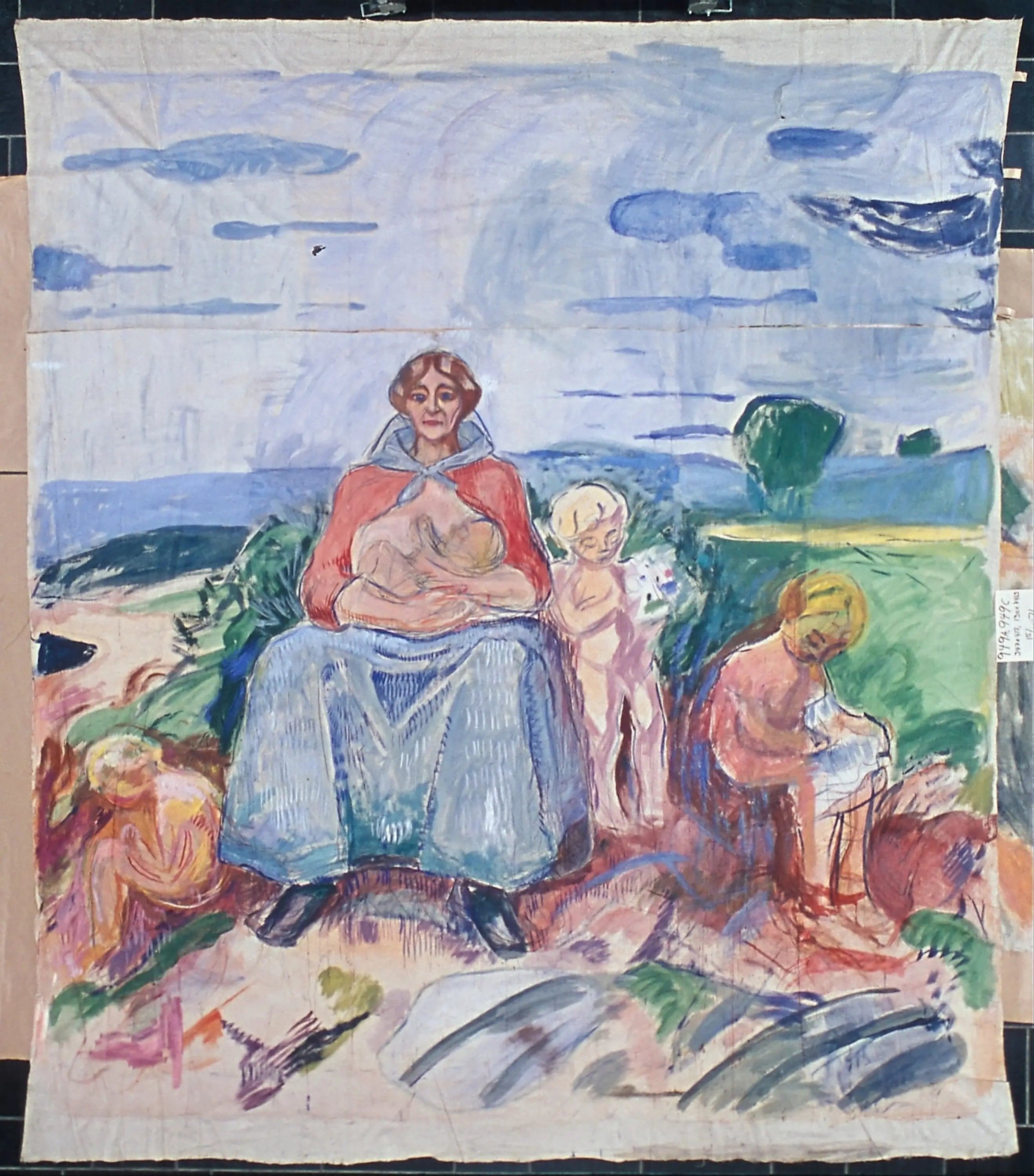
Alma Mater: central part
- Original dimensions
- 409 x 351 cm
- Museum
- Munch Museum
- Year
- 1914
Scene depicted
The painting “Alma Mater : central part” by Munch presents a scene rich in symbolism . One can discern human figures interacting, representing the bond that unites generations and the impact of education on the formation of identity. The composition thus becomes a tableau of intertwined feelings, revealing both sufferings and hopes related to human relationships.
Historical context
Created in 1914, this iconic painting is a poignant representation of the human psyche, deeply rooted in the city of Oslo, Norway. Belonging to the expressionist movement, Alma Mater : central part stands out for its intense exploration of human emotions, at a time when Europe was on the brink of historical upheavals. Today, this painting carefully preserved at the Munch Museum, recalls the genius of the painter through its notable dimensions.
Place in the artist's career
This painting is situated at a turning point in Munch's career, marking the peak of his quest for the expression of emotions. By combining this work with other masterpieces, such as “The Madonna” and “The Scream”, one can observe his stylistic and emotional evolution, reflecting both internal struggles and deep reflections on human existence.
Anecdote
“The cry of the soul manifests itself in my canvases” Munch might have declared while observing the scenes of life around him. In this painting, inspired by the echo of a spring morning in Oslo, each brushstroke captures not only the essence of a face but also the entirety of the human condition. This moment of inspiration is beautifully translated in the evocative power of Alma Mater : central part .