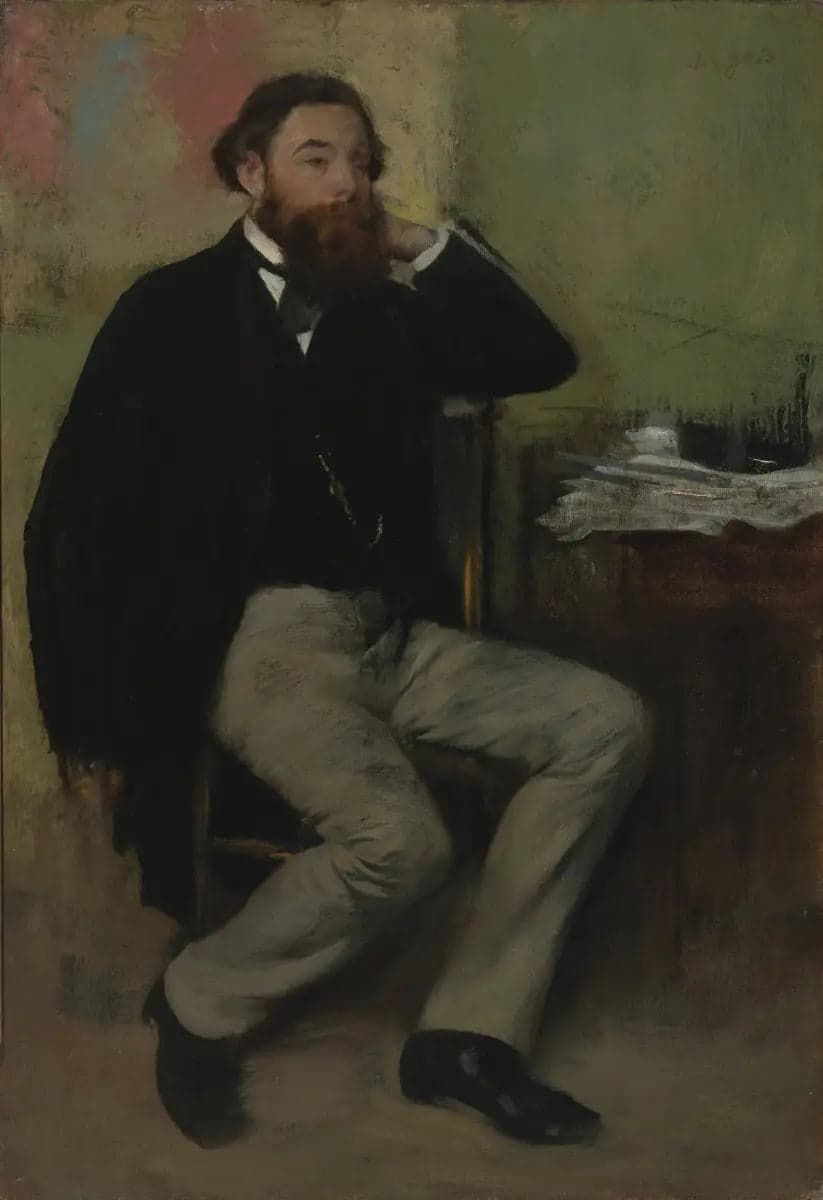
Alfred Niaudet
- Original dimensions
- 32 x 46 cm
- Museum
- Virginia Museum of Fine Arts
- Year
- 1877
Scene depicted
This canvas illustrates an elegant ball, full of life and harmony. The canvas captures an ephemeral moment, dancers moving with unceasing grace, while light plays on their costumes, creating an atmosphere imbued with refinement. The composition immerses us in the heart of a celebration, inviting us to share in the jubilation of the protagonists.
Historical context
Created in 1877, this painting is emblematic of the Impressionist era in Paris, a vibrant city where art and innovation coexist. In this historical context, Edgar Degas , at the crossroads of realism and impressionism , captures fleeting moments of urban life. This canvas is currently housed at the Virginia Museum of Fine Arts , testament to the cultural and artistic heritage of its time.
Place in the artist's career
The “Alfred Niaudet” represents a significant milestone in the career of Edgar Degas , positioned between his promising beginnings and his period of maturity. This pictorial work evokes the artist's growing mastery, akin to his other creations such as ballerinas and café scenes, where he expresses his unique style and attention to human details.
Anecdote
Degas once whispered: “Dance is a dream of passion, a moment frozen in time.” It was on a bustling street corner, one spring morning, that he was inspired by ballet — these bodies in motion wrapped in grace and light. This original emotion resonates through the “Alfred Niaudet,” where the painting reveals a magical moment captured for eternity.