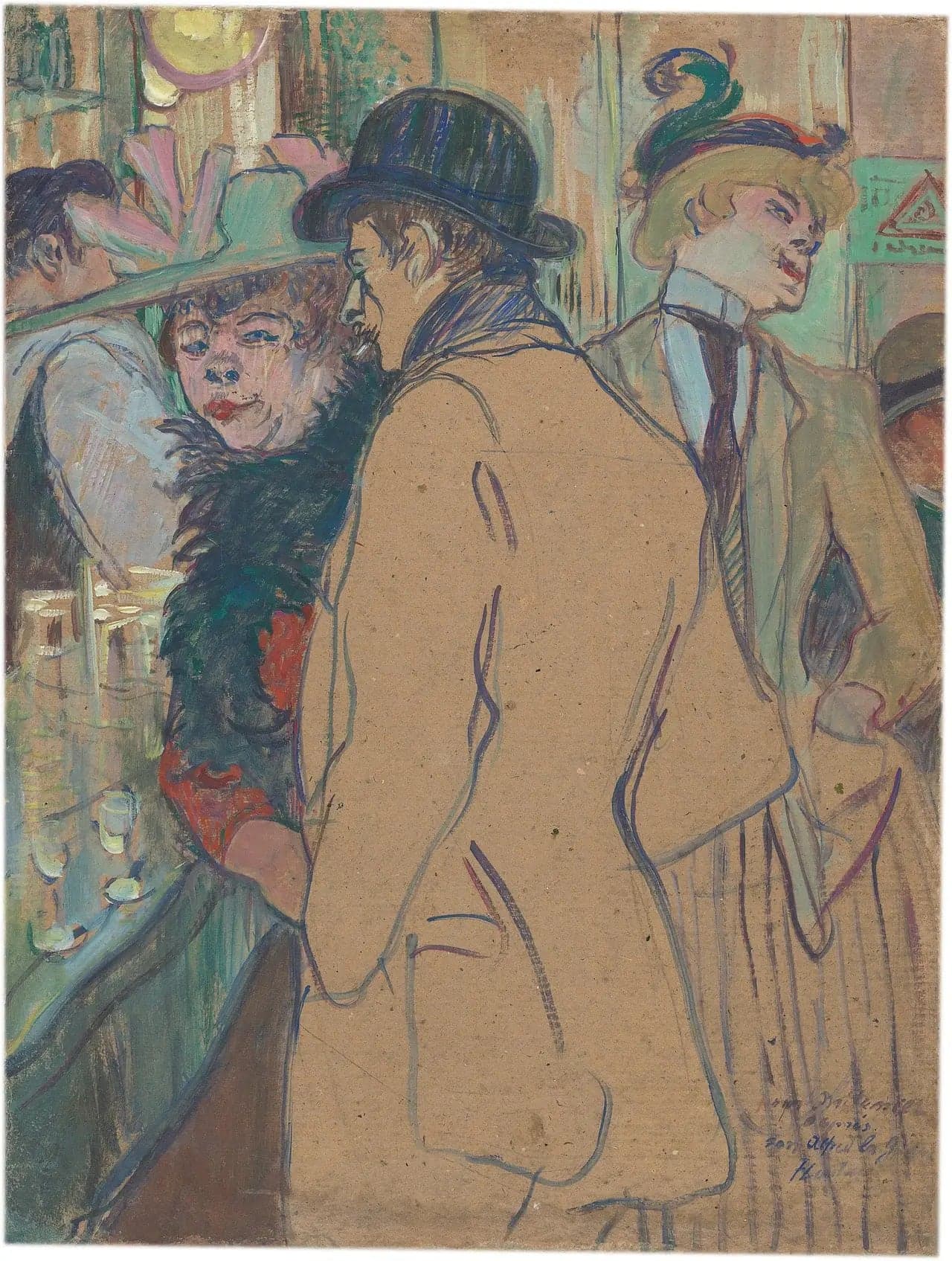
Alfred la Guigne - Henri de Toulouse
- Original dimensions
- 50.4 x 65.6 cm
- Museum
- National Gallery of Art
- Year
- 1894
Scene depicted
This painting depicts with precision the jovial and playful figure of Alfred, a famous circus clown, who embodies the carefree and festive spirit of his time. The composition, rich in details, reveals the nuances of his character and the atmospheres of the world of entertainment, thus creating a strong emotional connection with the viewer. Toulouse-Lautrec demonstrates a sharp eye on social realities while bringing a touch of softness to this scene of life.
Historical context
Created in 1894, in the heart of the Belle Époque in Paris, the painting titled Alfred la Guigne is part of a significant artistic movement that redefined the social and artistic representations of the time. Toulouse-Lautrec, a true emblematic figure of post-impressionism , captures here a vibrant moment of existence. Currently, this painting is displayed at the National Gallery of Art , highlighting its historical and aesthetic importance.
Anecdote
“Every face tells a story, every smile, a melody.” Henri de Toulouse-Lautrec found his inspiration one morning of willow and colors in a sunlit alley, where the innocence of childhood seemed to dance with the melancholy of adults. It is this duality that is found in the evocative power of the painting Alfred la Guigne .