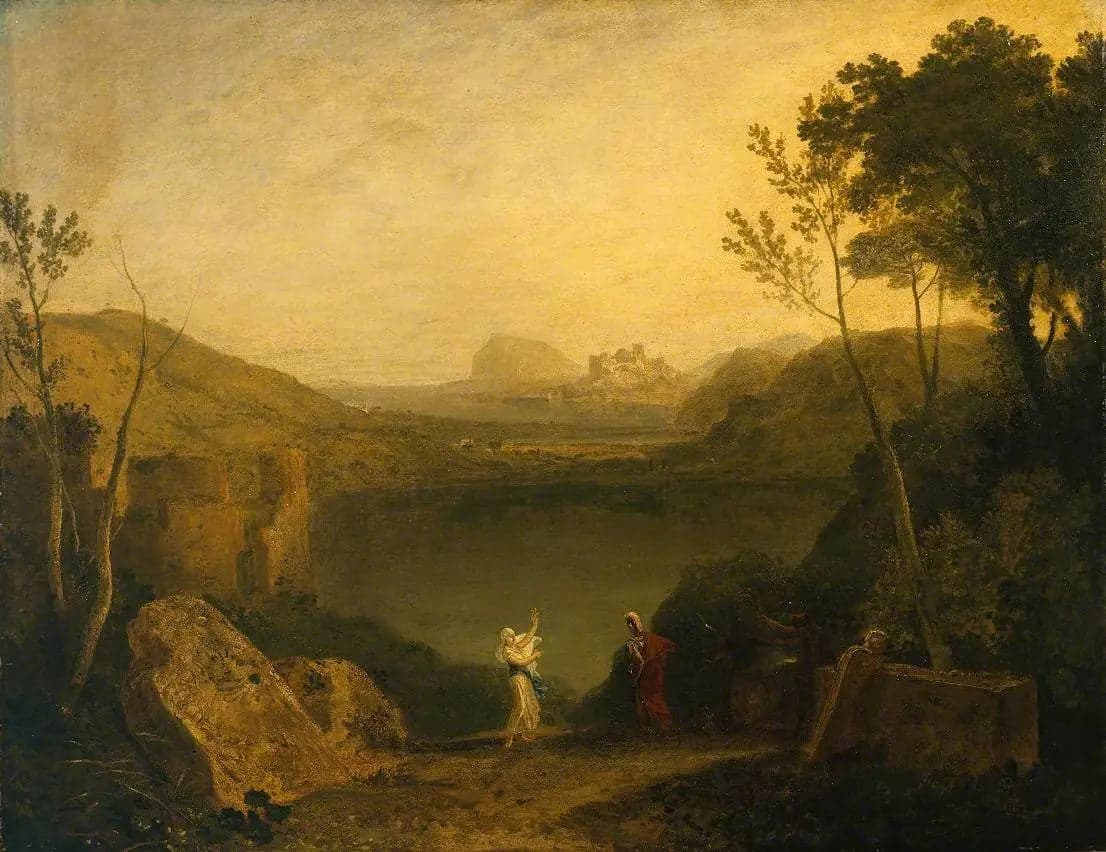
Aeneas et la Sibylle, Lac Avernus
- Original dimensions
- 76.5 x 98.4 cm
- Museum
- Tate
- Year
- 1798
Scene depicted
This painting illustrates a scene drawn from Virgil's Aeneid, in which Aeneas, the Trojan hero, consults the Sibyl, an oracle. Their journey into the heart of the mysteries of the afterlife is rendered with palpable intensity, while the dramatic landscape of Lake Avernus becomes both setting and character, highlighting the crossing between the world of the living and that of the dead.
Historical context
Created in 1798, this canvas emblematic finds its roots in the romantic movement, established in London, where light and emotion intertwine. The painting is today preserved at the Tate , in England, offering a striking view of Lake Avernus, imbued with a dramatic atmosphere that perfectly reflects the era.
Place in the artist's career
Aeneas and the Sibyl, Lake Avernus is part of Turner’s promising beginnings, where he begins to explore light and emotion. Compared to his two other paintings , The Deluge and The Fighting Temeraire, this composition already reveals a technical mastery that will be perfected over the decades, symbolizing the pinnacle of his romantic style.
Anecdote
“Every brushstroke is an invocation to the fleeting beauty of nature,” Turner is said to have declared when referring to his painting . Inspiration came to him one spring morning, as he stood on the mysterious shores of Lake Avernus, captivated by the enveloping mist and the whispers of the wind. This pictorial work resonates with the echoes of that moment, merging reality and dream.