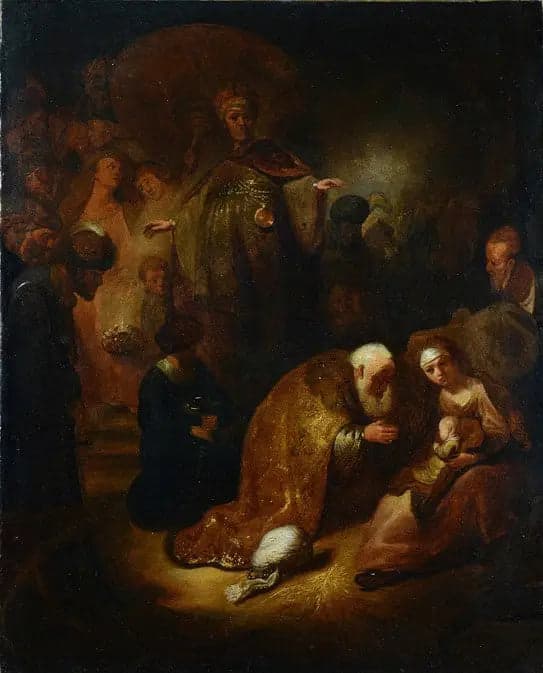
Adoration of the Magi
- Original dimensions
- 104.4 x 123.4 cm
- Museum
- Royal Collection
- Year
- 1660
Scene depicted
In the composition of Adoration des Mages , Rembrandt illustrates the sacred meeting between the kings and the newborn, creating a warm atmosphere imbued with devotion. The painting captures a moment of revelation: the kings, crowned with their ornaments, have gathered around the divine light emanating from the child, symbolizing hope and faith. The viewer is invited to feel the intimacy of a scene where love and devotion meet.
Historical context
Created in 1660, in the city of Amsterdam, Adoration des Mages is at the heart of the Baroque , an emblematic movement of the time. Under the signature of Rembrandt , this painting comes to life in a rich cultural setting, where artistic expression transcends simple forms to capture the essence of human spirituality. Currently exhibited at the Royal Collection, in London, this canvas measures 104.4 x 123.4 cm, revealing every detail of a composition that has marked the history of art.
Place in the artist's career
This painting represents a highlight in the career of Rembrandt , showcasing his mastery at the heart of his artistic maturity period. Placing it alongside The Night Watch and The Self-Portrait , one observes a significant technical evolution, through which his style is distinguished by its innovative use of light and textures, consolidating his reputation as one of the undisputed masters of the Baroque .
Anecdote
“Art is the light that penetrates the soul.” These words often resonated in the mind of Rembrandt as he painted. One peaceful morning, in the heart of Amsterdam, a glance exchanged with a passerby inspired the brightness of the work . This canvas , Adoration des Mages , evokes the depth of human emotions and spiritual connection, transcended by the play of light and shadow.