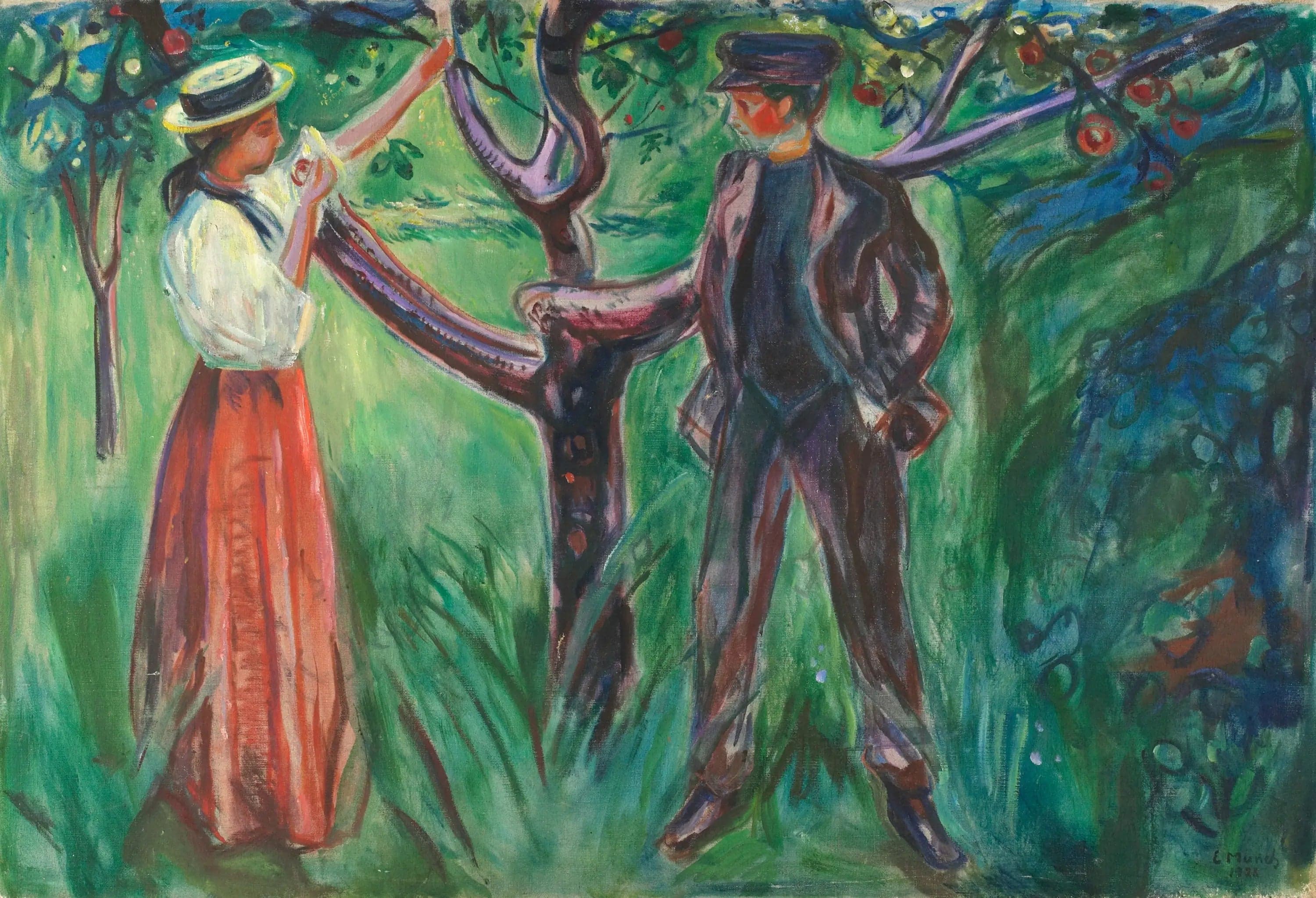
Adam and Eve
- Original dimensions
- 145 x 111.5 cm
- Museum
- Munch Museum
- Year
- 1909
Scene depicted
This canvas illustrates the myth of Genesis, highlighting the lost innocence of Adam and Eve in the face of temptation. Munch manages to convey the fragility of human emotions through tormented figures, emphasizing the struggle between desire and guilt, a poignant portrait of the state of the soul.
Historical context
Created in 1909, the painting Adam and Eve is set against the vibrant backdrop of Oslo, then the capital of a culturally thriving Norway. Drawing inspiration from symbolism , this canvas stands out for its exploration of themes of passion and mortality, characteristic of the artistic movement that profoundly influenced the work of Edvard Munch . Currently, this masterpiece is displayed at the Munch Museum, where visitors can appreciate the depth of its composition.
Place in the artist's career
Adam and Eve represents a milestone in the career of Edvard Munch , marking a phase of artistic maturation. Alongside his paintings such as The Scream and The Madonna, he explores motifs of vulnerability and humanity here, showing an evolution not only technical but also emotional in his artistic practice.
Anecdote
“I want to capture the essence of existence,” Munch is said to have remarked when discussing his masterpiece. Inspired by a spring walk, surrounded by floral scents and the whispers of nature, he was carried away by an inner vision, giving birth to the soul of this canvas that transcends time.