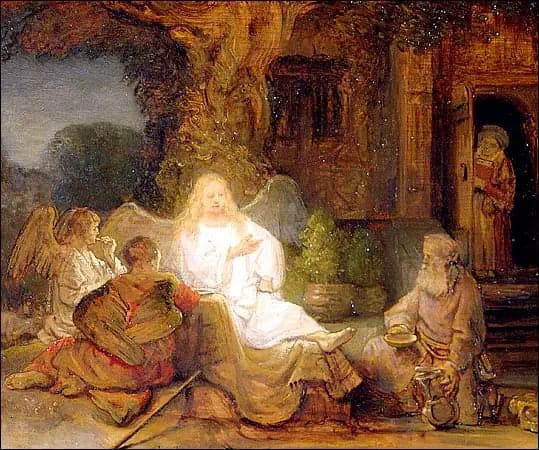
Abraham and the Three Angels
- Original dimensions
- 21.1 x 16.1 cm
- Movement
- Dutch golden age
- Museum
- private collection
- Year
- 1646
Scene depicted
This painting evokes the encounter of Abraham with three angelic travelers. The luminous faces and delicate gestures of these figures symbolize the invitation to hospitality. The atmosphere, initially marked by surprise, quickly transforms into a communion between the earthly and the heavenly.
Historical context
Created in 1646, in the city of Leiden, this iconic work is part of the Dutch golden age of painting. At that time, Rembrandt , magnifying light and shadow, brought sacred narratives to life within a prolific cultural context. Today, this painting is in a private collection, thus preserving its mystery and timeless beauty.
Place in the artist's career
“Abraham and the three angels” is part of a period of maturity for Rembrandt , as he explores the nuances of humanity through biblical narratives. Alongside “The Starry Night” and “The Anatomy Lesson of Dr. Tulp,” these paintings demonstrate his evolution where light plays a crucial role in the emotion conveyed.
Anecdote
“Light is the soul of the canvas,” said Rembrandt , inspired by a spring morning when the sun filtered through the sails of his window. This luminous moment, made famous by his painting , resonates in the delicacy of the angelic figures standing before Abraham. In this vibrant scene, he captures a divine intimacy, conveyed through each brushstroke.