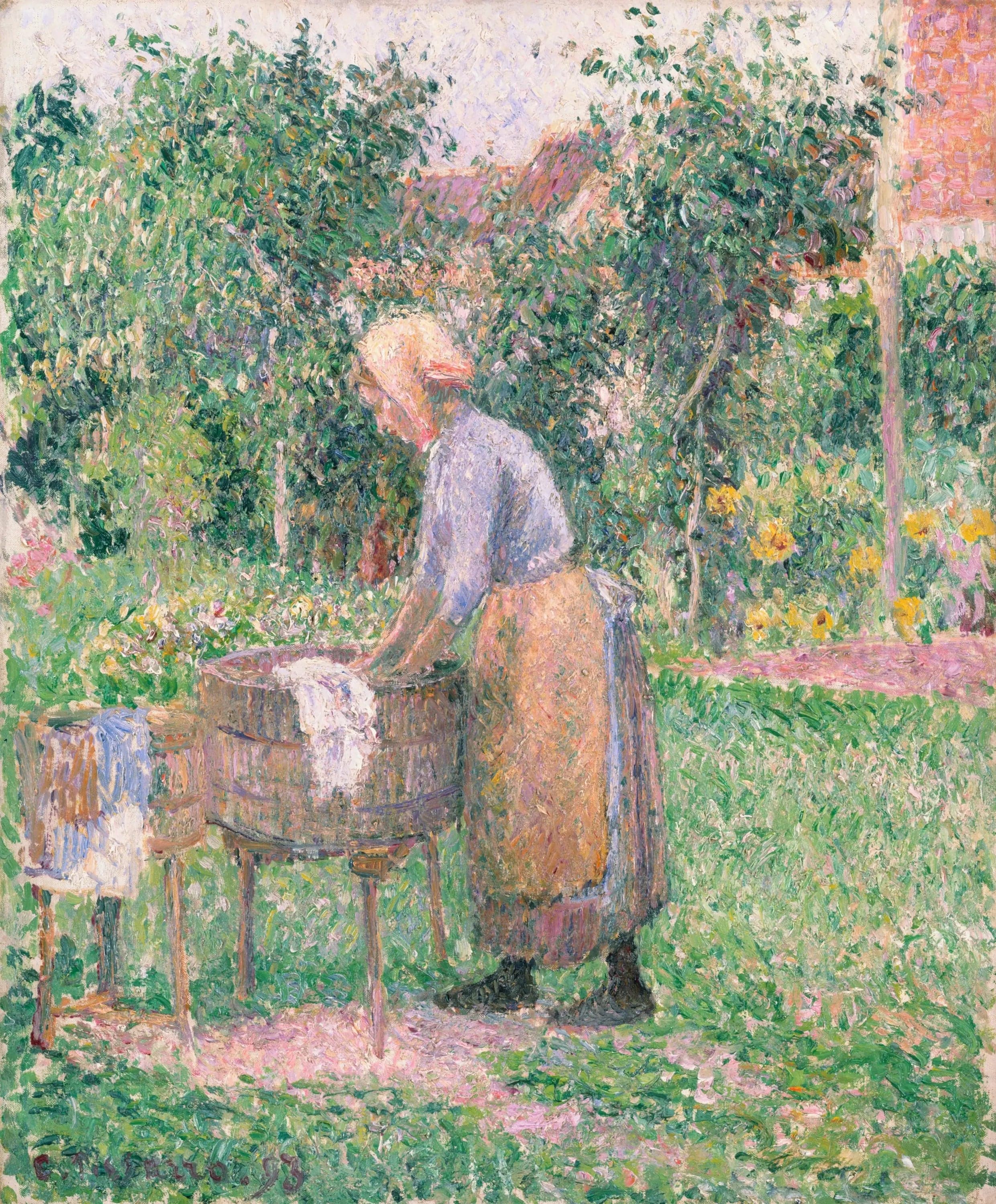
A Washerwoman at Éragny
- Original dimensions
- 38.1 x 45.7 cm
- Museum
- Metropolitan Museum of Art
- Year
- 1893
Scene depicted
In this painting, Pissarro invites us to observe a washerwoman, bent over her work. The fluid gestures, the light playing on the water, and the shades of green and blue blend into perfect harmony. This moment of serenity, imbued with labor and nature, immerses us in a peaceful daily life, far from urban agitation.
Historical context
Created in 1893, this painting is set in the charming village of Éragny, France. Pissarro, an iconic figure of the Impressionist movement, captures here a moment of daily life, while witnessing an era where nature and agricultural work were in symbiosis. The painting is currently housed at the Metropolitan Museum of Art in New York, where it continues to move generations.
Place in the artist's career
This painting is situated at a period of maturity for Pissarro, where his Impressionist style takes full form. Alongside other paintings such as “Boulevard Montmartre, Spring” and “The Artist's Garden at Éragny,” one observes an evolution towards a deeper exploration of colors and atmospheres.
Anecdote
“Every blade of grass, every reflection on the water is a promise of eternity,” said Pissarro while contemplating the scene that would bring this masterpiece to life. It is a bright April morning, where the air filled with floral fragrances and the murmur of the stream inspired this canvas delicate.