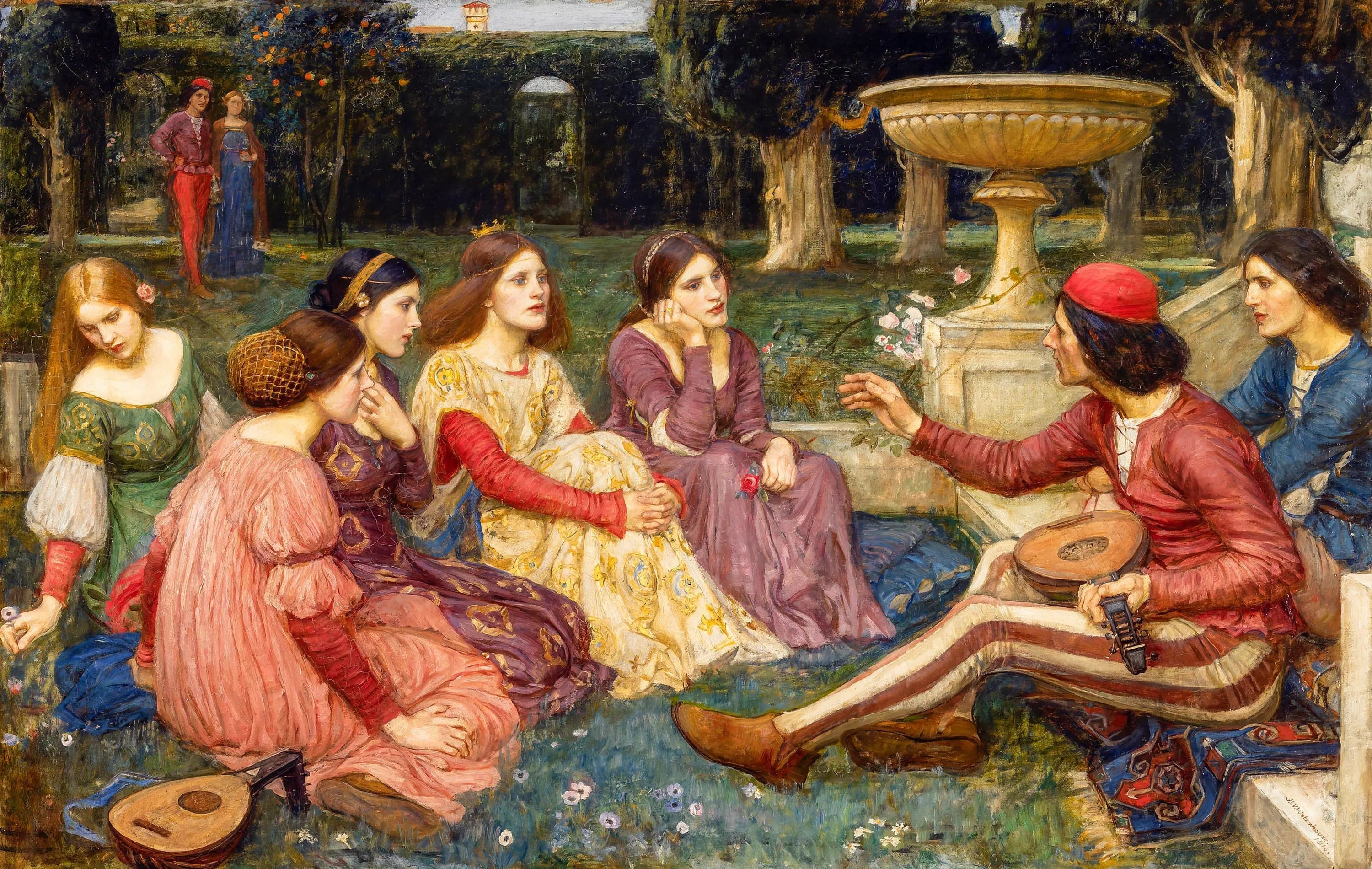
A Tale from the Decameron
Scene depicted
At the heart of A Tale from the Decameron , a young woman is immersed in her thoughts, surrounded by lush nature. The delicate play of light and shadow creates an enchanting atmosphere that contributes to the love and passion story woven into this painting. The elements of nature seem to form a symbiosis with the heroine, immersing the viewer in a universe of poetic delight.
Historical context
Completed in 1916, this painting comes to life in London, the capital of the United Kingdom, where John William Waterhouse draws his inspiration from the Pre-Raphaelite movement. This painting is set against a rich cultural backdrop, an artistic excitement dear to that time. Currently, the work is located at the Manchester Art Gallery, revealing its dimensions of 86.2 cm by 131.9 cm, a majestic format that captivates all gazes.
Place in the artist's career
A Tale from the Decameron represents a significant milestone in the career of John William Waterhouse , at the crossroads between his promising beginning and his stylistic peak. In parallel, Summer Day and A Nymph at the Spring demonstrate the evolution of his work towards an increasingly refined complexity. The omnipresent golden and saturated light evokes a thematic continuity around love and nature.
Anecdote
“Art is a window to a world where beauty never fades.” These words resonate like an echo of sunny mornings by the Thames, when Waterhouse, crossing faces illuminated by golden light, decided to capture the essence of the masterpiece that becomes A Tale from the Decameron . This painting is the result of an introspective quest, where each brushstroke evokes a vibrant emotional depth.