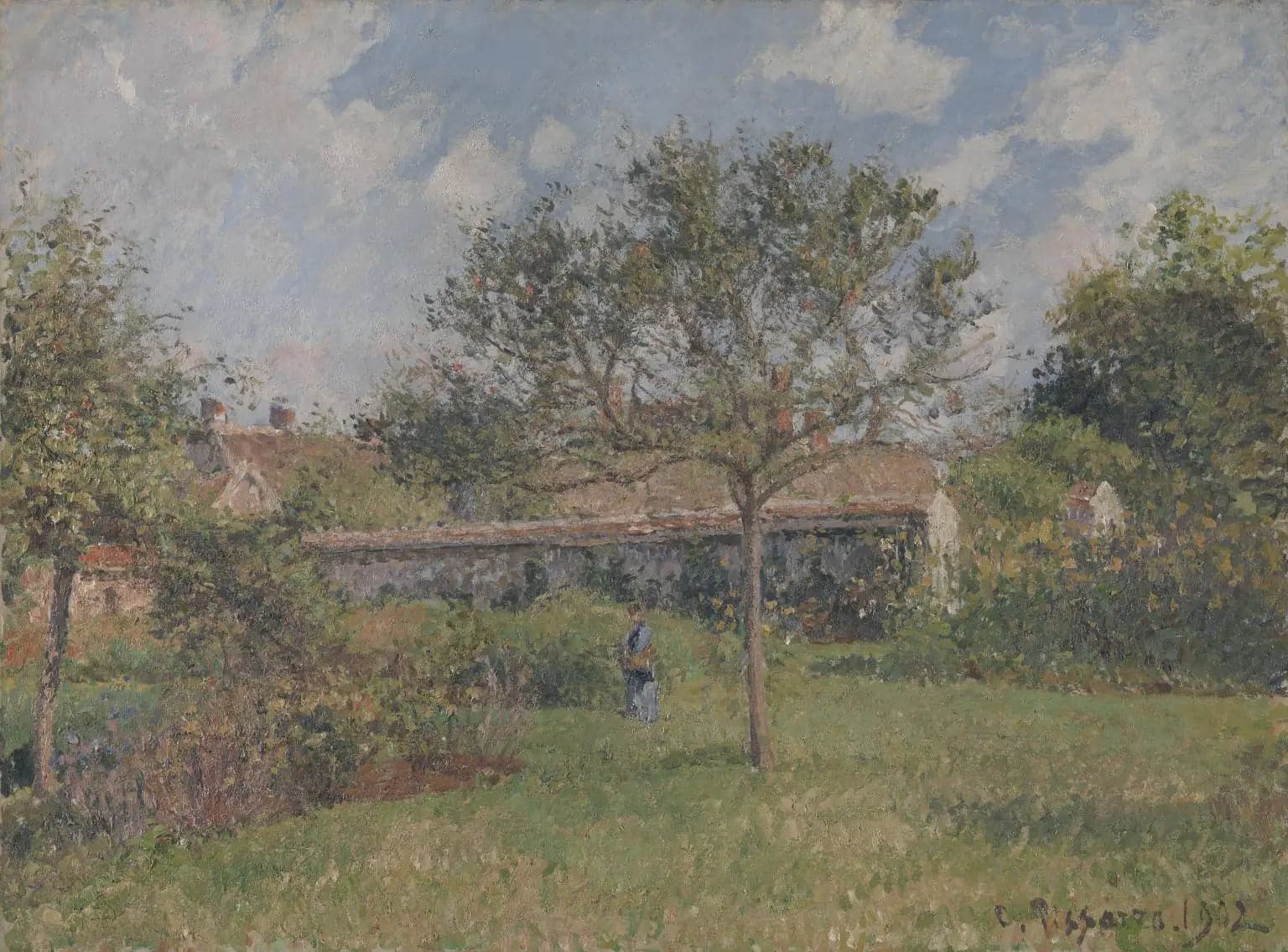
A Corner of the Meadow at Eragny
- Original dimensions
- 81.3 x 60 cm
- Museum
- Tate
- Year
- 1902
Scene depicted
In his painting “A Corner of the Meadow at Eragny,” Pissarro captures a bucolic scene where peasants engage in rural tasks, all bathed in soft, golden light. This pictorial work evokes not only the beauty of nature but also the unbreakable bond between man and his environment. The composition is a dance of colors, where each stroke of paint reflects a moment of daily life, imbued with calm and tranquility.
Historical context
Created in 1902, the painting A Corner of the Meadow at Eragny is one of the emblematic works of the Impressionist movement, set in the both bucolic and historical framework of Normandy. This masterpiece by Camille Pissarro transports us to the heart of France, in the village of Eragny, where nature and light meet, creating a lively and vibrant atmosphere. Currently housed at the Tate in England, this canvas measures 81.3 x 60 cm, a size that amplifies the beauty and details of the scene.
Place in the artist's career
This painting is a key milestone in Pissarro's career, illustrating his mature style and innovative approach. Between his masterpiece “Boulevard Montmartre, Spring” and “The Potato Harvest,” he charts a notable evolution where light and color take on predominant importance. A Corner of the Meadow at Eragny testifies to his constant search to capture the fleeting beauty of nature.
Anecdote
“Nature is an uninterrupted work of art, every piece of land has a story to tell.” These words from Camille Pissarro resonate like the echo of a spring morning, where, lost in his thoughts, he let himself be inspired by the blooming fields and the play of light dancing on the grass. It is this emotion, imbued with serenity, that animates his painting , making A Corner of the Meadow at Eragny a true hymn to nature.