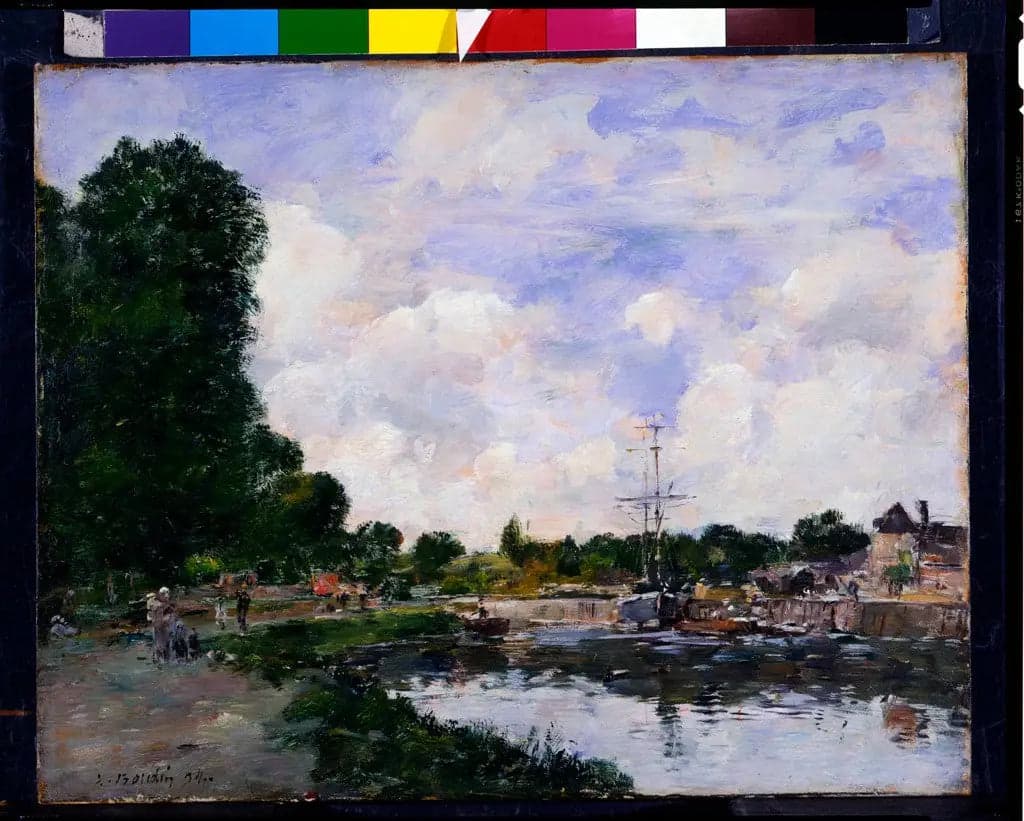
A Canal in Abbeville
- Original dimensions
- 41 x 32.4 cm
- Museum
- Harvard Art Museums
- Year
- 1894
Scene depicted
In this painting, Boudin offers us a tranquil scene where nature reveals itself in all its splendor. The reflections of trees and old buildings on the water create an atmosphere of serenity. The composition, harmonious, embodies the perfect union between the sky and the aquatic element, transporting the viewer to instant calm.
Historical context
Created in France in 1894, this painting is part of the Impressionist movement, an artistic current that captured the fleeting essence of natural landscapes. In Abbeville, a city rich in history, Eugène Boudin found an ideal setting to immortalize the reflection of light on water. Today, the painting is carefully preserved in the Harvard Art Museums , testifying to the importance of the work in the history of art.
Place in the artist's career
Positioned as an essential milestone in Boudin's career, A Canal in Abbeville reflects his period of artistic maturity. It is a significant landmark, whose technical finesse can be related to other emblematic works of the artist, such as The Beach at Trouville and The Sailboats at Honfleur , which also illustrate his talent for capturing the subtleties of light.
Anecdote
“Art is a journey, and this painting is the testimony of an escape by the water,” Boudin might have said while reminiscing about the creation of this masterpiece . Imagine him, on a sunny morning, by the shores of Abbeville, inspired by the cries of seagulls, the salty smell of the canals, and the shimmering dance of light on the calm waters.