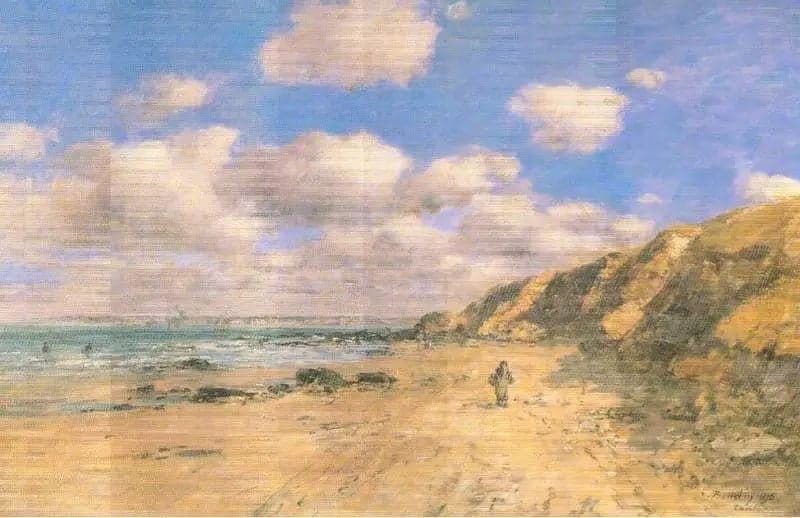
A Beach Near Trouville
- Original dimensions
- 81.2 x 54.3 cm
- Museum
- Barber Institute of Fine Arts
- Year
- 1895
Scene depicted
The painting "A Beach Near Trouville" evokes a sweet summer day where a group of characters gathers to enjoy the seaside. The white sails shimmer in the distance, while the azure hues of the ocean blend with the pastel colors of the sky. The human figures, barely sketched, infuse a joyful dynamic into the painting, inviting the viewer to feel the intoxication of a fleeting moment, shared in all simplicity.
Historical context
Created in 1895, the painting "A Beach Near Trouville" is at the heart of the Impressionist tradition, an innovative movement that highlights the fleeting nuances of nature. In the seaside resort of Trouville, Normandy, this painting depicts the charm of French beaches, capturing a moment of life on this popular coast where artists and holidaymakers mingled. The painting is currently housed at the Barber Institute of Fine Arts , offering visitors a valuable glimpse into a vibrant and colorful era.
Place in the artist's career
This painting is situated at a turning point in Boudin's career, oscillating between his promising beginnings and the peak of his Impressionist style. At that time, he was already painting works like "The Beach at Trouville" (1869) and "The Port of Honfleur" (1880), where he distinguished himself through his bold use of light and maritime atmosphere, making him an essential precursor of Impressionism as we know it today.
Anecdote
“The sea is my muse, each wave whispers a story to those who know how to listen.” These words of Eugène Boudin resonate when observing the inspiration that gave birth to this masterpiece . On that spring morning, on the Norman shore, the scents of iodine mixed with the laughter of children playing in the sand must have inspired the artist, allowing him to translate onto the canvas an atmosphere that is both serene and lively.