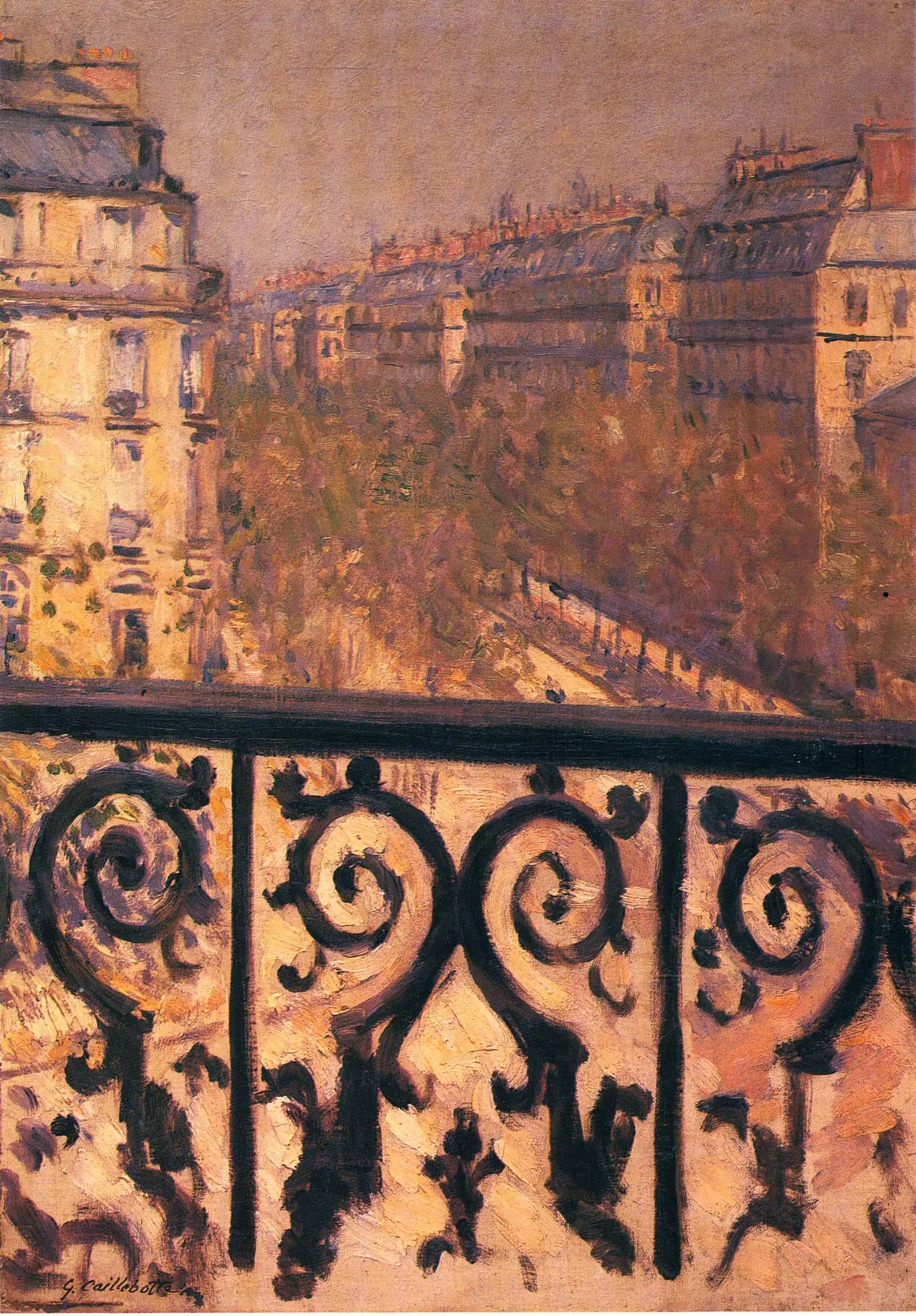
A Balcony in Paris
- Original dimensions
- 38.4 x 55.3 cm
- Museum
- Not specified
- Year
- 1880
Scene depicted
In this painting, Caillebotte offers us a striking view from a Parisian balcony, where sunlight bathes the scene. Human silhouettes, modern architectural elements, and urban life extending as far as the eye can see are clearly distinguishable. Every detail, from the lush green leaves to the endless blue sky, creates a vibrant atmosphere, revealing the diversity of human emotions within the great city. The work stands out for its ability to illustrate the conviviality of ordinary moments, thus anchoring the viewer in a palpable universe.
Historical context
Created in 1880, this canvas is emblematic of the vibrant setting of Paris, at the heart of the Impressionist movement. At a time when the city was undergoing spectacular transformations, A Balcony in Paris captures a fleeting moment imbued with modernity. Caillebotte's painting not only evokes the dynamism of urban life but also resonates with the soul of the capital at that time. Currently, this painting is not displayed in any known museum, but it remains a precious asset among collectors. Its dimensions of 38.4 by 55.3 cm remind us of the intimacy of a daily scene.
Place in the artist's career
This painting marks a significant transition in Caillebotte's career. A testament to his mature style, A Balcony in Paris aligns with other works, such as The Rows of Plane Trees and The Bridge of Europe , which also highlight his interest in visual storytelling and the exploration of perspective. This masterpiece embodies the pinnacle of his artistic quest to capture the spirit of his time.
Anecdote
“Life plays out on this balcony, in a light that only artists can capture.” This is what Gustave Caillebotte undoubtedly felt as he settled down to paint this work. Inspired by a sunny morning, he chose this precise location to represent the nuanced beauty of everyday life, illustrating how each moment can be transfigured by art. Thus, A Balcony in Paris becomes a vibrant echo of the emotion found in moments shared between light and shadow.